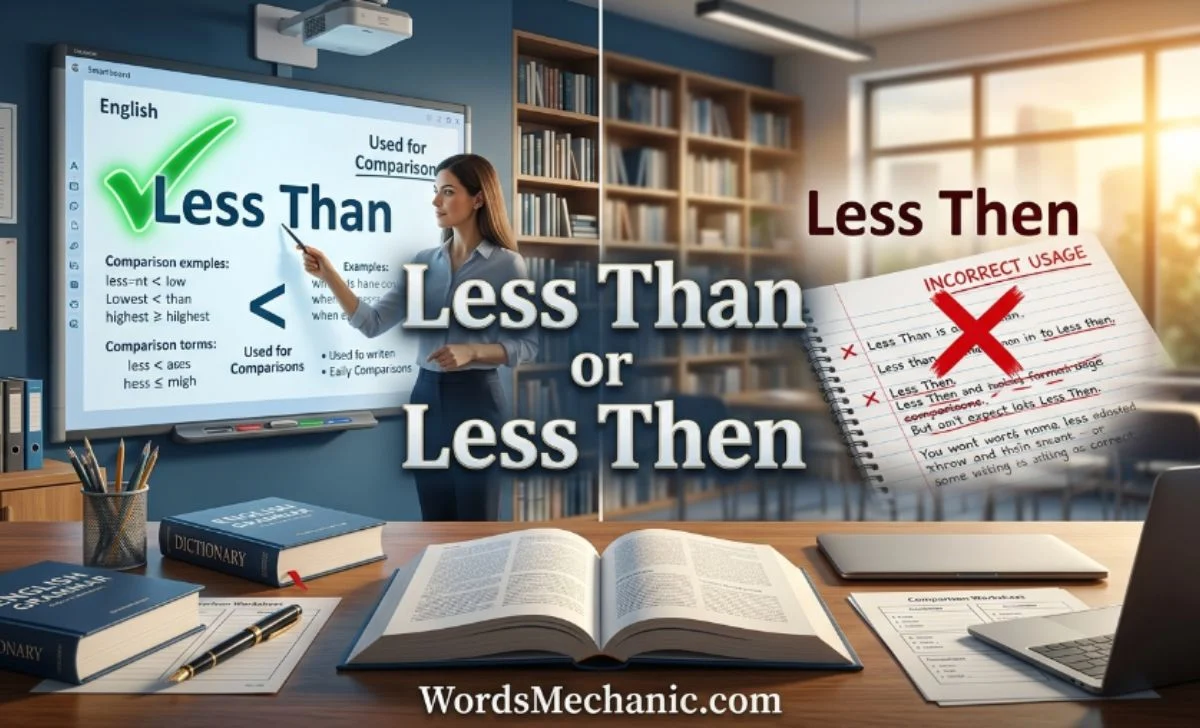
If you’ve ever paused mid-sentence wondering whether to write “less than” or “less then,” you’re dealing with one of English’s sneakiest mix-ups.
The two phrases look almost identical, differ by just one letter, and even sound nearly the same when spoken out loud , which is exactly why so many people type the wrong one without noticing.
This mistake shows up everywhere: text messages, emails, product descriptions, even published articles.
It’s not a sign of poor English skills , it’s simply a spelling trap that catches native speakers and learners alike, because than and then are both perfectly real, correctly spelled words. Your spell checker won’t flag it, so the only real fix is knowing the rule.
Quick answer
✅ Less than 20 students attended the meeting. ✅ The phone costs less than $500. ❌ Less then 20 students attended the meeting.
Here’s the short version of why: than is used to compare two things. Then is used to talk about time or what happens next.
Since “less than” is always a comparison (a smaller amount compared to something else), it needs than , never then.
That one-letter difference trips up even confident writers, because than and then sound almost the same when spoken.
Below, you’ll get the grammar rule, real examples, the math symbol version, and a trick to help it stick for good.
Why “Than” and Not “Then”
Than is a conjunction used for comparison , placing one thing against another in terms of size, amount, age, price, or degree.
- This laptop costs less than the old one.
- We have less than ten minutes left.
- His salary is less than mine.
Then, on the other hand, has nothing to do with comparison. It signals time, order, or sequence , what happens after something else.
- Finish your homework, then watch TV.
- We had dinner, then went for a walk.
Notice the difference in function: one sentence type stacks two things side by side (comparison), the other lines up two events in order (sequence). “Less than” only ever does the first job, so then never belongs in it.
“Less Than” vs “Less Then” Side by Side
| Correct | Incorrect |
|---|---|
| The trip took less than an hour. | The trip took less then an hour. |
| She earns less than her brother. | She earns less then her brother. |
| The package weighs less than 2 kg. | The package weighs less then 2 kg. |
| We have less than five minutes left. | We have less then five minutes left. |
Every comparison needs than. There’s no exception to this — “less then” isn’t a regional variant, an informal shortcut, or an accepted alternative. It’s simply incorrect.
What Does “Less Than” Actually Mean?
“Less than” means a smaller amount, number, or degree compared to something else. It shows up constantly in everyday writing:
- Money: The repair cost less than $100.
- Time: We waited less than an hour.
- Weight: The package weighs less than two kilograms.
- Distance: The hotel is less than five miles away.
- Percentage: The battery is less than 20% charged.
You’ll see it in emails, shopping sites, news articles, business reports, and school assignments — basically anywhere someone needs to express “not quite as much as.”
The Less Than Symbol (<)
In math and programming, “less than” has a symbol: <
It shows that the number on the left is smaller than the number on the right.
- 5 < 8
- 15 < 25
- 99 < 100
The symbol always reads as “less than” , never “less then.” If you’re writing 5 < 8 in a sentence, you’d say “5 is less than 8.”
A quick way to remember the direction: the pointed end of the symbol always faces the smaller number, while the open end faces the larger one.
Some people picture it as an alligator’s mouth opening toward the bigger number because it “wants to eat” the larger amount.
The related symbol > means “greater than,” and it works the same way in reverse:
- 12 > 7 (12 is greater than 7)
- 20 > 15 (20 is greater than 15)
“Less Than” vs “Fewer Than”
This is a separate mix-up worth knowing, since the two phrases often get confused with each other.
- Use less than for things measured in bulk , money, time, weight, distance. Less than $50. Less than two hours. Less than five miles.
- Use fewer than for things you can count individually , people, books, chairs. Fewer than ten students. Fewer than five chairs.
Formal writing tends to respect this distinction more strictly than casual speech does. In an email to a friend, “less than 10 people showed up” won’t raise eyebrows.
In a formal report, “fewer than 10 people” is the more polished choice.
Common Mistakes to Watch For
Mistake 1 — Using then in a comparison: ❌ The box weighs less then five kilograms. ✅ The box weighs less than five kilograms.
Mistake 2 — Using than for sequence: ❌ Finish your homework, than watch TV. ✅ Finish your homework, then watch TV.
Mistake 3 — Assuming spell check will catch it: Since than and then are both real, correctly spelled English words, most spell checkers won’t flag the wrong one.
Grammar checkers catch it more often, but not always. This is exactly the kind of mistake that slips through unnoticed — which is why knowing the rule matters more than relying on software.
A Memory Trick That Actually Works
Here’s a simple way to lock this in permanently:
- Than = comparison. Both words have an “a.” Think: “faster than,” “against” something else.
- Then = sequence. Both words have an “e.” Think: “next event,” what happens after.
So: Than pairs with Against (comparison). Then pairs with nExt (time). If you’re stuck mid-sentence, ask yourself: “Am I comparing two things, or describing what happens next?” That question alone solves it almost every time.
FAQs
1. Is “less than” or “less then” correct?
“Less than” is correct. It’s used for comparisons , numbers, prices, sizes, amounts. “Less then” is a spelling error, since then only refers to time or sequence, never comparison.
2. What’s the actual difference between “than” and “then”?
Than compares two things (“She is taller than her brother”). Then marks time or what comes next (“Finish your homework, then watch TV”). One rule of thumb: if you can rephrase the sentence as “X is more/less [something] compared to Y,” you need than.
3. Is “less then” ever acceptable, even informally?
No. Unlike some grammar rules that loosen up in casual writing, this isn’t one of them. “Less then” is not a stylistic choice or dialect difference , it’s simply the wrong word.
4. What is the less than symbol, and how do I remember which way it points?
The symbol is <. The pointed end always faces the smaller number, and the open end faces the larger one. For example, in 5 < 8, the point sits next to 5.
5. Should I use “less than” or “fewer than” for people?
Use “fewer than” for countable things like people, books, or chairs (“fewer than ten students”). Use “less than” for amounts measured in bulk, like time, money, or weight (“less than an hour,” “less than $50”).
6. Is “less than” okay to use in formal writing?
Yes. It’s standard English and appears throughout academic writing, legal documents, business reports, and journalism. There’s nothing informal about it , the confusion only exists around its incorrect twin, “less then.”
Conclusion
So, is it “less than” or “less then”? It’s always “less than.” The word “then” is for time, not comparison, so it never belongs after “less.”
The good news is, this rule is easy once it clicks. Anytime you’re comparing an amount, a price, an age, or a distance, reach for than.
Anytime you’re talking about what happens next, use then. That’s really the whole rule.
And since spell check won’t catch this one for you, it’s worth remembering on your own. A quick habit helps: before you hit send, glance at the sentence and ask, “Am I comparing two things?” If yes, it’s than.
If you’re just describing a sequence of events, it’s then.Small rule, but it makes your writing look sharper.