You are writing a recipe post, a gift tag, or a school essay. Then you stop. Is it “homemade” or “home made”? This tiny question trips up more writers than you’d think.
The confusion happens because both forms look correct at first glance, and moreover, spell checkers do not always catch the mistake.
This article settles it for good. You will learn the correct spelling, when to use it, and why the wrong version keeps showing up in emails, menus, and social posts. By the end, you will never second-guess this word again.
Homemade or Home Made – Quick Answer
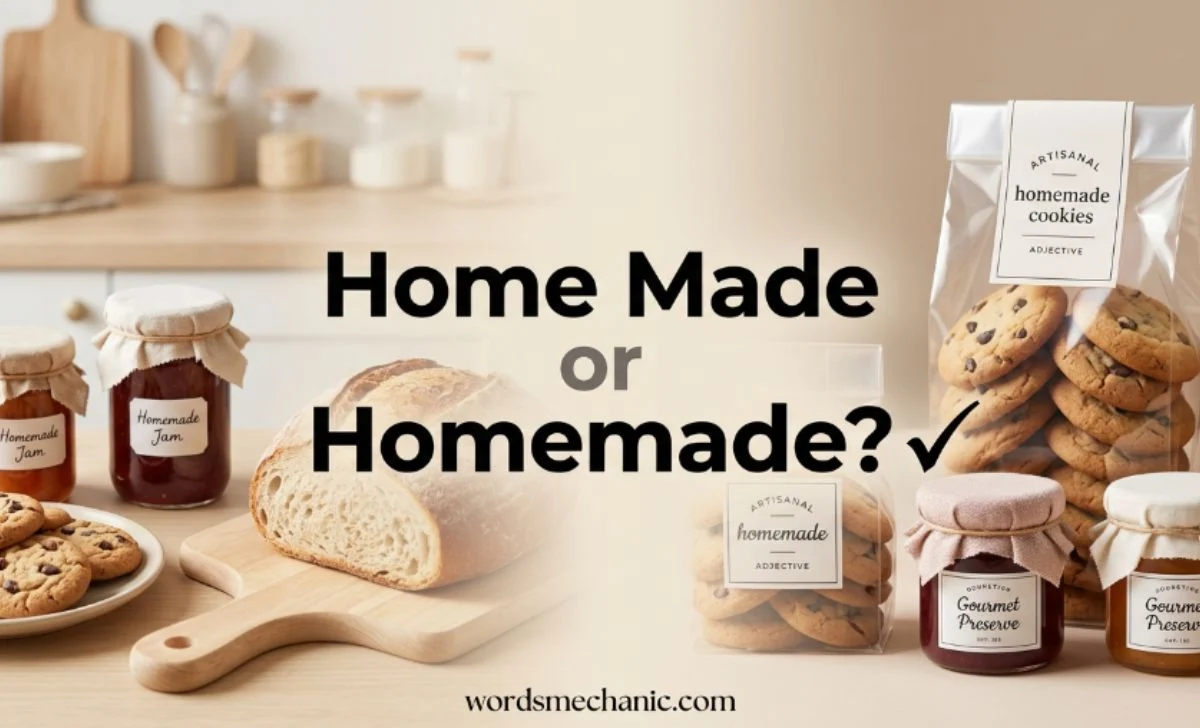
Homemade is the correct spelling. It is one word, written without a space or hyphen. This is true in almost every context: cooking, crafts, gifts, and everyday writing.
However, “home made” (two words) and “home-made” (hyphenated) are not standard in modern English. You may still see the hyphenated form in older British texts, but current style guides and major dictionaries list “homemade” as a single word.
For example, think of it like other compound adjectives that started as two words and merged over time, such as “haircut” or “birthday.” Homemade followed the same path.
Correct Example
“She baked a homemade apple pie for the party.”
“This soup tastes better than store-bought; it’s all homemade.”
Incorrect Example
“She baked a home made apple pie for the party.” ❌
“This soup tastes better than store-bought; it’s all home-made.” ❌ (outdated style)
What Does Homemade Mean?
Homemade is an adjective. It describes something made at home, by hand, rather than bought from a store or made in a factory. As a result, it signals a personal touch, care, and often a higher quality than mass-produced goods.
Common Meanings
- Food made at home – bread, jam, pasta, sauces.
- Crafts or gifts made by hand – candles, cards, knitted items.
- Simple tools or fixes built without professional help – a homemade shelf, a homemade fix for a leaky pipe.
- Informal or improvised solutions – “a homemade remedy,” “a homemade explanation.”
Simple Usage Examples
| Sentence | Meaning |
|---|---|
| “He gave her a homemade card.” | Made by hand, not bought |
| “The bakery sells homemade bread daily.” | Made on-site, not shipped in |
| “That’s a homemade fix, but it works.” | A DIY solution |
| “Her homemade jam won first prize.” | Made personally, not store-bought |
In addition, homemade always comes before the noun it describes, just like “delicious” or “fresh.” You would say “a homemade meal,” not “a meal homemade.”
The Origin of Homemade
Word History
Homemade comes from two Old English roots: “ham,” meaning dwelling or home, and “macian,” meaning to make or shape.
Over centuries, English speakers combined many two-word phrases into single compound words once the phrase became common enough. Similarly, “homemade” followed the same route as “handmade,” “homework,” and “homesick.”
Early printed use of the compound form appears in cookbooks and household guides from the 1800s, where writers described food “home made” as a way to distinguish it from shop-bought goods. By the twentieth century, dictionaries had standardized it into one word.
Why the Confusion Happens
Three things cause the mix-up:
- Old texts still show the hyphenated or spaced form, so people copy that style without realizing language has moved on.
- Meanwhile, autocorrect is inconsistent. Some tools flag “homemade” as wrong when it is not, especially on mobile keyboards.
- Finally, compound words evolve slowly, and readers see both forms often enough that neither looks obviously wrong.
Indeed, this same pattern happens with words like “email” (once “e-mail”) and “website” (once “web site”). Overall, language simplifies over time, and homemade is a clear example of that shift.
Homemade, Home-Made, and Home Made – Which Form Survives Today?
Unlike true regional spelling differences (like “color” vs “colour”), homemade is not split by country.
In fact, both American and British English now treat it as one word in modern style guides. Therefore, the variation you see is more about era than region.
Comparison Table
| Form | Status | Where You’ll See It |
|---|---|---|
| Homemade | Correct, modern standard | Recipes, packaging, everyday writing, both US and UK |
| Home-made | Outdated, rarely used now | Older British books, vintage signage |
| Home made | Incorrect as an adjective | Informal writing, signage, casual social posts |
Notably, major dictionaries, including Merriam-Webster and Oxford, list “homemade” as the single accepted form.
Likewise, style guides for journalism, academic writing, and business communication also treat it as one word.
Homemade vs Other Variations
Spelling Comparison Table
| Spelling | Correct or Incorrect | Typical Usage | Notes |
|---|---|---|---|
| Homemade | Correct | “homemade bread,” “homemade gift” | Standard in US and UK English |
| Home made | Incorrect (as adjective) | Casual writing, signs | Reads as two separate words, changes meaning |
| Home-made | Outdated | Older texts | Once common, now rare |
| Homade | Incorrect | Typo | Missing the “e” from “home” |
| Hommemade | Incorrect | Typo | Extra letter, common typing error |
As a quick way to remember: if you can say “hand made” and it still sounds slightly old-fashioned, the same logic applies to “homemade.” Both compressed into single words as English simplified compound adjectives.
Which Spelling Should You Use?
US Audience
Use “homemade.” American style guides, including AP Style, treat it as a single word in all contexts.
UK Audience
Use “homemade” as well. Modern British dictionaries no longer recommend the hyphen. Consequently, if you are editing older UK content, you can safely update “home-made” to “homemade” without changing meaning.
International Writing
For international or ESL audiences, “homemade” is the safest and most recognized form worldwide, since it avoids confusion because it is used the same way in both major English variants.
Academic Writing
Academic style guides (APA, MLA, Chicago) do not list “home made” or “home-made” as acceptable. Therefore, always write it as one word in essays, papers, and reports.
Social Media Usage
On social media, people often type “home made” out of habit or speed, but it is still technically incorrect. If you want your captions to read as polished and professional, stick with “homemade.”
Common Mistakes with Homemade
Frequent Errors
- Splitting it into two words: “home made cookies”
- Adding an unnecessary hyphen: “home-made cookies”
- Confusing it with “hand made,” which follows a similar but separate pattern
- Using it as a noun instead of an adjective: “I love homemades” (incorrect)
- Misplacing it after the noun: “cookies homemade” instead of “homemade cookies”
Corrected Examples
| Incorrect | Corrected |
|---|---|
| “I made this home made.” | “I made this at home.” or “This is homemade.” |
| “Home made pizza night!” | “Homemade pizza night!” |
| “It’s a home-made solution.” | “It’s a homemade solution.” |
| “She sells home mades at the market.” | “She sells homemade goods at the market.” |
Homemade in Everyday Examples
Emails
“Attached is the recipe for the homemade granola bars I mentioned at lunch.”
Social Media
“Sunday mood: homemade pasta and slow cooking. 🍝 #homemade #fromscratch”
News Writing
“The bakery’s homemade bread has become a local favorite, drawing customers from across the city.”
School Writing
“For the science fair, I built a homemade volcano using baking soda and vinegar.”
Business Writing
“Our homemade sauces are prepared fresh daily using locally sourced ingredients.”
Across every context, therefore, “homemade” stays one word. In other words, formality does not change the spelling.
Why This Word Gets Searched So Often
People search “homemade or home made” mainly because they are writing something in the moment , a recipe caption, a product label, a school assignment , and want to avoid an obvious mistake before hitting publish or submit.
Generally, it is a quick spelling check, not a deep grammar question, which is why searchers usually want a fast, clear answer rather than a long explanation.
This kind of search is common in English-speaking regions where homemade goods, from food to crafts, are widely marketed and discussed online.
Specifically, small business owners, home bakers, bloggers, and students are the most frequent searchers, since they use the word often in product descriptions, recipes, and everyday writing.
Related Grammar Rules
Similar Spelling Mistakes
Many compound adjectives face the same two-word vs one-word confusion:
- Handmade, not “hand made”
- Homegrown, not “home grown”
- Homework, not “home work”
- Homesick, not “home sick” (note: “home sick” as two words has a different, literal meaning)
- Storebought, often still written as “store-bought” with a hyphen, unlike homemade
Helpful Grammar Tips
- Check if the phrase acts as a single describing word. If yes, it usually compounds into one word over time.
- Also, look it up in a current dictionary, not an old book or forum post.
- When in doubt, search the word alone. If dictionaries show one accepted spelling, use that one everywhere for consistency.
- Additionally, be consistent within one document. Do not switch between “homemade” and “home-made” in the same piece.
- Above all, trust modern style guides over old habits, since language changes, and compound words are one of the fastest-changing areas.
FAQs
1. Is “homemade” one word or two?
It is one word: homemade.
2. Is “home-made” with a hyphen ever correct?
It was once common in older writing but is considered outdated today.
3. What does homemade mean?
It means made at home rather than bought from a store or factory.
4. Is “home made” grammatically wrong?
Yes, as an adjective before a noun, it should be written as one word: homemade.
5. Do the British spell it differently than Americans? No. Both British and American English use “homemade” as the standard spelling today.
6. Can “homemade” be used as a noun? No, it functions only as an adjective, such as “homemade bread.”
7. Is “homemade” formal enough for academic writing? Yes, it is accepted in formal, academic, and professional writing.
8. Why do some websites still use “home-made”? Older content or non-updated style guides sometimes keep the hyphenated version.
9. What is the opposite of homemade? Store-bought, factory-made, or commercially produced are common opposites.
10. Is “homemade” the same as “handmade”? Not exactly. Homemade refers to something made at home, often food, while handmade refers to something crafted by hand, often objects or crafts.
11. How do you use homemade in a sentence? Example: “We had homemade soup for dinner.”
12. Is homemade one word in British English too? Yes, current British dictionaries list it as one word.
13. What’s a synonym for homemade? Household-made, self-made, or homegrown, depending on context.
14. Can you say “homemade by me”? It’s more natural to say “made by me at home” or simply “homemade,” since “homemade by me” is slightly redundant.
15. Is “home made” acceptable in casual texting? It is common but still technically incorrect; “homemade” remains the standard.
16. Does autocorrect fix “home made” automatically? Not always. Many keyboards do not flag it as an error.
17. Is “homemade” hyphenated when used before a noun? No, it stays as one word: “a homemade cake,” not “a homemade-cake.”
18. What tense is “homemade”? It is not a verb, so tense does not apply. It functions purely as an adjective.
19. Is “homemade” capitalized in titles? Only follow standard title-case rules, capitalizing it like any other adjective when required.
20. Can homemade describe non-food items? Yes, it applies to crafts, gifts, tools, and DIY projects as well as food.
21. Is there a plural form of homemade? No, “homemade” itself does not change form; only the noun it describes becomes plural, such as “homemade cookies.”
22. Why do recipe blogs use “homemade” so often? Because it signals quality, care, and a personal touch compared to store-bought alternatives.
Conclusion
In short, “homemade” is the correct spelling, written as one word with no space or hyphen. By contrast, “home made” and “home-made” are outdated or incorrect in modern English, whether you write for a US or UK audience.
The word describes anything made at home rather than bought or factory-produced, from food to crafts to simple fixes.
Overall, the most common mistake is splitting it into two words out of habit or old style. Going forward, therefore, use “homemade” consistently in recipes, captions, emails, and formal writing.
It is a small detail, but ultimately, getting it right keeps your writing clean, professional, and easy to trust.
Discover More Blogs :
- Well Known or Well-Known: A Complete Explanation of the Hyphen Rule
- Wholly or Wholely: What English Dictionaries Recommend
- Focused or Focussed: The Definitive Spelling Guide
- Tonight or Tonite: One Word, Two Spellings, Clear Answer
- Counselor or Councillor: UK and US English Differences Explained