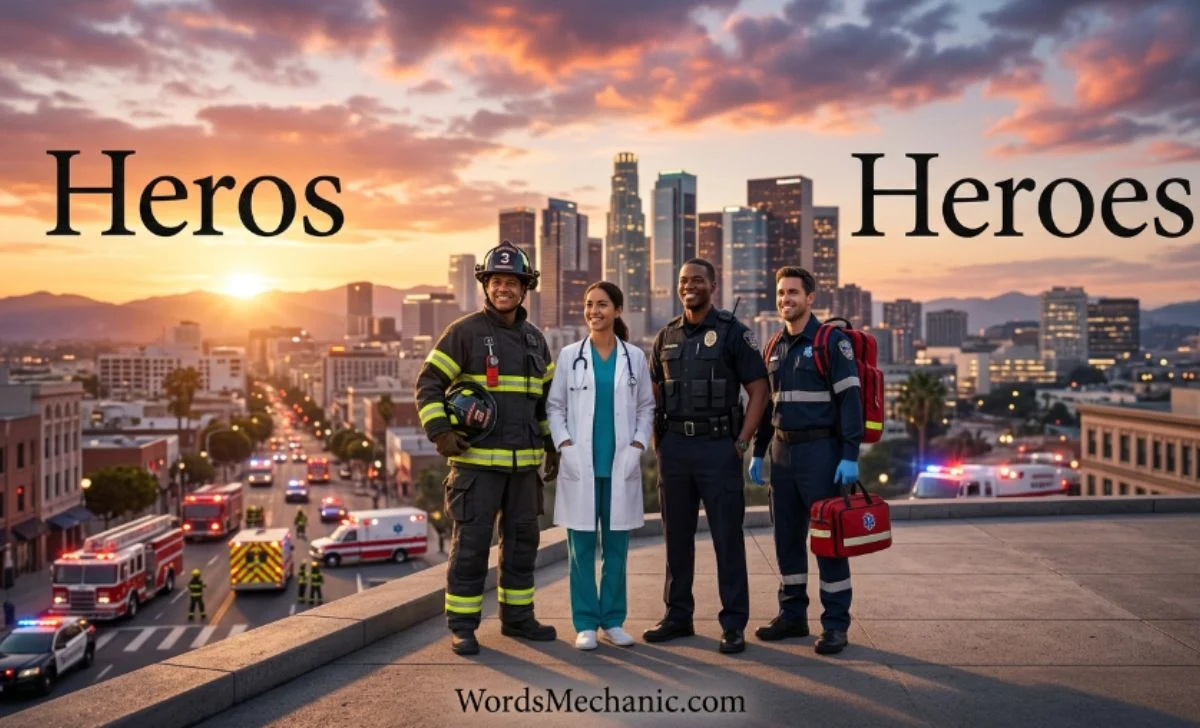
Choosing between heros and heroes is a common challenge for English learners and even native speakers.
Since many English nouns simply add -s to form the plural, it’s easy to assume that heros is correct. However, standard English follows a different rule for the word hero.
Understanding that rule not only helps you avoid spelling mistakes but also improves your grammar and writing confidence.
In this guide, you’ll learn the correct plural form, why heroes is correct, why heros is incorrect, pronunciation, grammar rules, and plenty of real-life examples.
Quick Answer
Heroes is the correct plural of hero. Heros is a spelling mistake and is not accepted in standard English.
| Word | Correct? | Meaning |
|---|---|---|
| Hero | ✅ Yes | One brave or admired person |
| Heroes | ✅ Yes | More than one hero |
| Heros | ❌ No | Incorrect spelling |
The rule is straightforward: use hero when referring to one person and heroes when referring to two or more.
Whether you’re writing an essay, email, article, or social media post, heroes is the only correct plural form recognized by dictionaries and style guides.
Heros vs Heroes at a Glance
| Feature | Hero | Heroes | Heros |
|---|---|---|---|
| Spelling Status | Correct | Correct | Incorrect |
| Number | Singular | Plural | Not a standard English word |
| Part of Speech | Countable noun | Countable noun | Misspelling |
| Pronunciation | /ˈhɪroʊ/ | /ˈhɪroʊz/ | — |
| Example | She is a hero. | They are heroes. | ❌ They are heros. |
This comparison shows the entire difference in one place. Hero is the singular noun, heroes is its correct plural, and heros should never be used in formal or informal English because it isn’t a recognized spelling.
What Does “Hero” Mean?
A hero is an adult or young person admired for courage, bravery, noble actions, achievements, or selfless service.
While the word traditionally referred to someone who performed extraordinary acts, modern English also uses it for people who inspire others through kindness, leadership, sacrifice, or determination.
In literature, a hero is often the main character who faces challenges and drives the story forward. In everyday life, a hero can be anyone whose actions positively impact others.
Definition
A hero is a singular countable noun, meaning it refers to one individual and has a plural form (heroes).
Examples
- The firefighter became a hero after rescuing two children.
- My mother is my biggest hero.
- The young doctor was praised as a hero during the health crisis.
- Every community has a hero who quietly helps others.
- The film tells the story of an unlikely hero.
These examples demonstrate that hero always refers to one person. If you’re talking about multiple people, switch to heroes.
Common Uses of “Hero”
Everyday Conversation
- My grandfather is my hero.
- She’s a local hero because of her volunteer work.
Literature
The central character who overcomes obstacles is often called the hero or protagonist.
Sports
A player who scores the winning goal is frequently described as the team’s hero.
Healthcare
Doctors, nurses, and emergency responders are often celebrated as heroes for their commitment to saving lives.
Military and Public Service
Soldiers, police officers, firefighters, and rescue workers are commonly honored as heroes because of their courage and dedication.
These examples show that the word hero is used far beyond comic books or mythology. It describes anyone whose actions earn respect and admiration.
Is “Heros” a Word?
No. Heros is not a correct English word.
It appears because many learners apply the regular plural rule by simply adding -s to hero. However, English spelling doesn’t work that way for every noun ending in -o.
Why Is “Heros” Incorrect?
The noun hero belongs to a group of words that usually form the plural by adding -es.
Examples include:
- hero → heroes
- potato → potatoes
- tomato → tomatoes
- echo → echoes
Because of this established spelling rule, dictionaries, grammar books, and professional editors all recognize heroes as the correct plural.
Why Do People Misspell It?
There are several reasons why heros appears frequently online.
- Learners assume all nouns become plural by adding -s.
- The -o plural rule isn’t always taught in detail.
- Typing quickly can lead to spelling errors.
- Some English words ending in -o do take -s, creating confusion.
Understanding the rule is much more effective than memorizing a single word because it helps you spell many similar nouns correctly.
Why Is the Plural “Heroes”?
Unlike regular nouns such as book → books or teacher → teachers, hero follows the -o + es plural pattern.
| Singular | Plural |
|---|---|
| Hero | Heroes |
| Potato | Potatoes |
| Tomato | Tomatoes |
| Echo | Echoes |
| Mosquito | Mosquitoes |
These nouns end in -o and commonly form their plurals by adding -es. The extra letters make the words easier to pronounce and follow long-established English spelling conventions.
Why Doesn’t It Become “Heros”?
If English followed only one plural rule, heros might seem logical. However, English developed from several languages and contains many historical spelling patterns.
Over time, heroes became the accepted standard and remains the only correct plural found in dictionaries and educational resources.
The -O Plural Rule
One of the most useful spelling rules in English involves nouns ending in -o.
Many of these nouns add -es to form the plural.
| Singular | Plural |
|---|---|
| Hero | Heroes |
| Potato | Potatoes |
| Tomato | Tomatoes |
| Echo | Echoes |
| Torpedo | Torpedoes |
| Mosquito | Mosquitoes |
These examples follow the traditional -o + es pattern and are commonly taught in schools.
However, not every -o noun follows this rule.
Important Exceptions
| Singular | Plural |
|---|---|
| Photo | Photos |
| Piano | Pianos |
| Radio | Radios |
| Video | Videos |
| Studio | Studios |
| Kangaroo | Kangaroos |
These nouns simply add -s instead of -es. Because English contains both patterns, it’s important to learn common examples rather than assuming every word ending in -o behaves the same way.
Quick Tip: If you’re unsure, check a reliable dictionary. With frequent exposure, these spelling patterns become much easier to remember.
Heros vs Heroes: Key Differences
| Feature | Heros | Heroes |
|---|---|---|
| Dictionary Status | Not accepted | Accepted |
| Correct English | ❌ No | ✅ Yes |
| Grammar | Incorrect | Correct plural |
| Academic Writing | Never use | Always use |
| Professional Writing | Avoid | Recommended |
| Meaning | None in standard English | More than one hero |
The table makes the distinction clear. Heroes is the only spelling accepted in standard English, while heros is considered a spelling error.
Using the correct form strengthens your writing, especially in academic, professional, and published content.
When Should You Use “Heroes”?
Use heroes whenever you’re referring to two or more people who are admired for bravery, achievement, or positive actions.
Examples:
- The rescue workers became national heroes.
- History remembers many heroes who fought for justice.
- The children thanked the everyday heroes in their community.
Should You Ever Use “Heros”?
In standard English, the answer is no.
The only time you might see heros is when discussing a spelling mistake or quoting someone’s original text. Otherwise, always write heroes.
Pronunciation Explained
Correct pronunciation supports clear communication and reinforces the correct spelling.
| Word | IPA | Pronunciation |
|---|---|---|
| Hero | /ˈhɪroʊ/ | HEER-oh |
| Heroes | /ˈhɪroʊz/ | HEER-ohz |
The pronunciation changes only slightly in the plural form. Heroes adds a soft /z/ sound at the end, while the stress remains on the first syllable in both words.
Pronunciation Tips
- Say hero as HEER-oh.
- Add a gentle z sound to pronounce heroes.
- Practice both words together to hear the difference naturally.
Practice Sentences
- Every child deserves a hero to look up to.
- The firefighters were true heroes.
- Teachers are everyday heroes for many students.
- The documentary honored forgotten heroes from history.
Reading these sentences aloud is an effective way to improve both your pronunciation and your confidence when using the correct singular and plural forms.
Common Grammar and Spelling Mistakes
Although the rule is straightforward, many learners still confuse hero, heroes, and heros. Most mistakes happen because English plural rules aren’t always consistent.
Recognizing these common errors will help you write with greater confidence.
Mistake 1: Adding Only -s
❌ The firefighters were heros.
✅ The firefighters were heroes.
Explanation:
The noun hero forms its plural by adding -es, not just -s.
Mistake 2: Using the Singular for More Than One Person
❌ Three hero received awards.
✅ Three heroes received awards.
Explanation:
Whenever you’re referring to two or more people, use the plural noun heroes.
Mistake 3: Using the Plural with a Singular Verb
❌ The heroes is ready.
✅ The heroes are ready.
Explanation:
Since heroes is plural, it must take a plural verb such as are, have, or were.
Mistake 4: Using the Singular After Numbers
❌ Five hero volunteered.
✅ Five heroes volunteered.
Explanation:
Numbers greater than one require the plural form.
Mistake 5: Confusing Similar -o Nouns
❌ hero → heros
✅ hero → heroes
❌ potato → potatos
✅ potato → potatoes
These examples show why it’s important to learn the common -o plural pattern instead of assuming every word simply adds -s.
Real-Life Usage Examples
Learning grammar becomes easier when you see words used in everyday situations.
Everyday Conversation
- My father has always been my hero.
- Healthcare workers became everyday heroes during difficult times.
- Every neighborhood has unsung heroes who quietly help others.
These examples show that hero often refers to ordinary people whose actions inspire others.
School Writing
Students frequently use these words in essays and assignments.
- The novel’s hero overcomes many challenges.
- Ancient heroes appear in many Greek myths.
- Our teacher asked us to write about national heroes.
Notice how hero is used for one character, while heroes describes multiple people.
News Headlines
Journalists regularly use heroes when reporting acts of courage.
- Local Heroes Rescue Family from Flood
- Doctors Honored as Community Heroes
- Everyday Heroes Recognized for Volunteer Work
Headlines often use heroes to celebrate groups of people who have made a positive impact.
Literature and Storytelling
The word hero is central to storytelling.
- Every great adventure begins with a hero.
- The heroes worked together to defeat the villain.
- Young readers often admire fictional heroes.
Whether in mythology, fantasy, or modern novels, heroes are usually the characters who drive the story forward.
Workplace and Business
The term isn’t limited to fiction.
- Customer service representatives became the company’s heroes during the crisis.
- The project succeeded because several team heroes stepped forward with creative solutions.
In professional settings, hero is often used metaphorically to praise exceptional performance.
Heroes in Modern English
Today, the meaning of hero extends far beyond warriors and legendary figures.
People commonly describe these individuals as heroes:
- Firefighters
- Doctors
- Nurses
- Teachers
- Soldiers
- Police officers
- Rescue workers
- Volunteers
- Parents
- Community leaders
The table below shows how the word is used in different contexts.
| Context | Example |
|---|---|
| Healthcare | Doctors became heroes during a health emergency. |
| Education | Teachers are everyday heroes for many students. |
| Sports | The goalkeeper was the team’s hero. |
| Community | Volunteers became local heroes after the cleanup campaign. |
| Military | Soldiers were honored as national heroes. |
These examples illustrate that hero can describe anyone whose courage, dedication, or kindness positively affects others.
Word Origin (Etymology)
Knowing where a word comes from often makes it easier to remember its spelling.
The English word hero comes from the ancient Greek word hērōs, meaning a protector, warrior, or person of extraordinary courage. It later entered Latin before becoming part of English.
Over time, English adopted the plural form heroes, following its established spelling conventions for many nouns ending in -o.
Although the meaning has broadened, the spelling has remained consistent for centuries.
Related Words and Similar Plurals
Learning similar words helps reinforce the spelling rule.
| Singular | Plural |
|---|---|
| Hero | Heroes |
| Potato | Potatoes |
| Tomato | Tomatoes |
| Echo | Echoes |
| Mosquito | Mosquitoes |
| Torpedo | Torpedoes |
These nouns generally follow the -o + es rule.
Now compare them with common exceptions.
| Singular | Plural |
|---|---|
| Photo | Photos |
| Piano | Pianos |
| Radio | Radios |
| Video | Videos |
| Studio | Studios |
| Kangaroo | Kangaroos |
The comparison shows that English doesn’t have one universal rule for every noun ending in -o. Learning frequently used examples is the most reliable approach.
Easy Memory Trick
Need a quick way to remember the correct spelling?
Think of this simple phrase:
A hero becomes heroes because brave people are never alone.
Another trick is to group similar words together.
- hero → heroes
- potato → potatoes
- tomato → tomatoes
If a word follows this familiar pattern, it usually takes -es in the plural.
You can also remember that heroes contains the word “es”, just like echoes and potatoes.
Mini Practice Quiz
1. Which spelling is correct?
A. Heros
B. Heroes
✅ Answer: Heroes
2. The firefighters were true ______.
A. hero
B. heroes
✅ Answer: Heroes
3. My grandfather is my ______.
A. hero
B. heroes
✅ Answer: Hero
4. Which sentence is correct?
A. The heros saved the village.
B. The heroes saved the village.
✅ Answer: The heroes saved the village.
5. Which word is a misspelling?
A. Hero
B. Heroes
C. Heros
✅ Answer: Heros
If you answered all five correctly, you’ve mastered one of the most common English spelling rules.
FAQs
Is heros a real English word?
No. Heros is a misspelling. The correct plural of hero is heroes.
What is the plural of hero?
The correct plural form is heroes.
Why is it heroes instead of heros?
Because hero belongs to a group of English nouns that typically add -es to form the plural.
Is hero a countable noun?
Yes. You can count one hero, two heroes, or many heroes.
Are there exceptions to the -o plural rule?
Yes. Words such as photo, radio, video, and piano simply add -s.
How do you pronounce heroes?
It is pronounced /ˈhɪroʊz/, with a soft z sound at the end.
Can heroes refer to ordinary people?
Absolutely. Today, the word often describes teachers, healthcare workers, volunteers, parents, firefighters, and anyone whose actions inspire or help others.
Is heroes used in academic writing?
Yes. Heroes is the only correct plural form used in schools, universities, books, newspapers, and professional writing.
Can hero describe a fictional character?
Yes. In literature, films, and mythology, the main character or protagonist is often called the hero.
What is the opposite of a hero?
Common opposites include villain, coward, or antagonist, depending on the context.
Conclusion
Choosing between heros and heroes is easier once you understand the grammar rule. Hero is the singular form, while heroes is the only correct plural in standard English.
Although heros may appear online, it is simply a spelling mistake and should be avoided in academic, professional, and everyday writing.
Remember the -o + es pattern, practice with real-life examples, and compare similar nouns like potato → potatoes and echo → echoes.
With these simple rules in mind, you’ll use hero and heroes accurately and confidently every time.