Have you ever written “braker” and wondered if it was the correct spelling? You’re not alone. This spelling confusion is surprisingly common because many people associate the word with brake, especially when talking about electricity or vehicles.
However, in standard English, only one spelling is correct. Understanding the difference is important for clear communication, whether you’re writing a business email, discussing a circuit breaker, or referring to a deal breaker in everyday conversation.
In this guide, you’ll learn which spelling is correct, why the confusion exists, what breaker actually means, and how to use it confidently in different contexts.
Quick Answer
Breaker is the correct spelling in standard English. It refers to someone or something that breaks, or to specific terms such as a circuit breaker, deal breaker, tie-breaker, or wave breaker.
Braker is not recognized as a standard English word and is considered a misspelling. If you’re writing in academic, professional, or everyday English, always use breaker.
Breaker vs. Braker at a Glance
| Feature | Breaker | Braker |
|---|---|---|
| Correct spelling | ✅ Yes | ❌ No |
| Dictionary recognized | Yes | No |
| Part of speech | Noun | Not a standard English word |
| Meaning | A person, device, or thing that breaks; also used in compound nouns | No accepted meaning |
| Formal writing | ✅ Correct | ❌ Incorrect |
| Professional writing | ✅ Correct | ❌ Avoid |
| Common usage | Very common | Usually a spelling mistake |
What Does “Breaker” Mean?
Definition
A breaker is a noun that generally means a person, object, or device that breaks something.
Depending on the context, it can also describe a protective electrical device, a powerful ocean wave, or an expression used in business, sports, and everyday communication.
Because it has several meanings, understanding the context is essential.
Common Meanings of “Breaker”
The word breaker appears in many areas of English.
Circuit Breaker
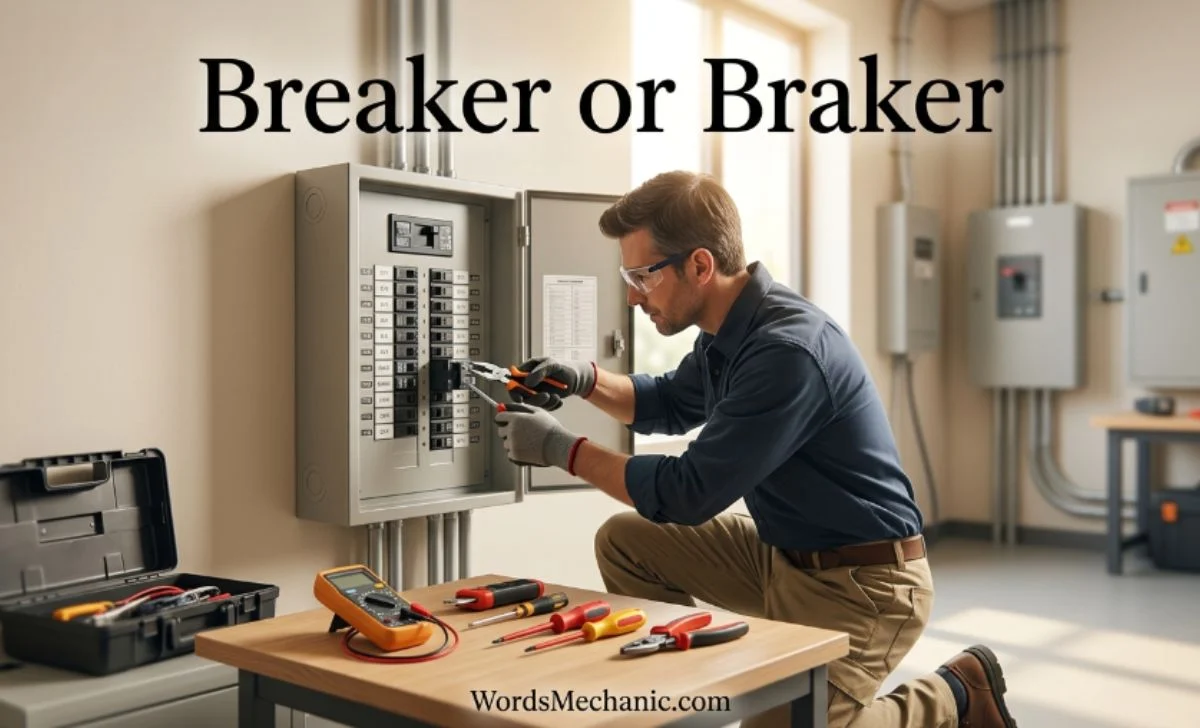
In electrical systems, a circuit breaker is a safety device that automatically stops the flow of electricity when it detects an overload or short circuit.
Example:
The electrician replaced the faulty circuit breaker before restoring power.
Deal Breaker
A deal breaker is something that makes an agreement, relationship, or opportunity unacceptable.
Example:
Poor communication is a deal breaker for many employers.
Tie-Breaker
In sports and competitions, a tie-breaker determines the winner when both sides finish with the same score.
Example:
The championship was decided by a tie-breaker.
Wave Breaker
A breaker can also refer to a large ocean wave that curls and crashes near the shore.
Example:
The surfers waited for the biggest breakers before entering the water.
Icebreaker
An icebreaker is an activity, question, or conversation starter that helps people feel more comfortable in social or professional settings.
Example:
The trainer began the workshop with a fun icebreaker activity.
Common Collocations with “Breaker”
Native English speakers often use breaker in these expressions:
- circuit breaker
- breaker panel
- breaker box
- breaker switch
- deal breaker
- tie-breaker
- icebreaker
- wave breaker
- record breaker
- lawbreaker
Learning these common combinations helps you understand how versatile the word is across different situations.
Is “Braker” a Real Word?
The Short Answer
No. Braker is not a standard English word.
Major English dictionaries recognize breaker, but they do not list braker as an accepted alternative spelling.
If you write braker in an essay, business report, email, or professional document, it will usually be marked as a spelling error.
Why Do People Write “Braker”?
There are two main reasons.
1. Confusion with “Brake”
Many people think breaker comes from the word brake, especially when discussing electrical systems or vehicles.
In reality, breaker comes from the verb break, not brake.
This is why the correct spelling keeps both letters “ea” from break.
2. Fast Typing
Typing quickly often causes people to omit one letter, resulting in braker instead of breaker.
Autocorrect may catch the mistake, but not always. That’s why it’s worth knowing the correct spelling yourself.
Is “Braker” Ever Acceptable?
In standard English, no.
You might occasionally see braker:
- in text messages,
- online comments,
- social media posts,
- or unedited drafts.
However, these are spelling mistakes rather than accepted forms of the word.
Whenever accuracy matters, always write breaker.
Break vs. Brake vs. Breaker vs. Braker
One reason this spelling mistake is so common is that several similar-looking words exist in English. Understanding how they differ makes choosing the correct spelling much easier.
| Word | Part of Speech | Meaning | Example |
|---|---|---|---|
| Break | Verb/Noun | To separate, damage, or interrupt something | Please don’t break the glass. |
| Brake | Noun/Verb | A device or action used to slow or stop a vehicle | Press the brake gently. |
| Breaker | Noun | A person, object, or device that breaks; also used in compound nouns like circuit breaker | The breaker tripped during the storm. |
| Braker | — | Not a standard English word | ❌ Incorrect spelling |
Notice that breaker is directly related to break, not brake.
This simple connection helps explain why the spelling includes “ea”.
Why Is “Breaker” the Correct Spelling?
English forms many nouns by adding -er to a verb.
Examples include:
| Verb | Noun |
|---|---|
| teach | teacher |
| build | builder |
| drive | driver |
| write | writer |
| break | breaker |
Following this pattern:
- break → breaker ✅
- brake → braker ❌ (not a standard English noun)
This is one of the easiest ways to remember the correct spelling.
If the word describes something that breaks, it should be spelled breaker.
How “Breaker” Is Used in Everyday English
Unlike many spelling-confusion words, breaker appears in a wide variety of situations.
At Home
You may hear someone say:
The circuit breaker tripped after we plugged in too many appliances.
At Work
A hiring manager might say:
Missing deadlines is a deal breaker for our company.
In Sports
Commentators often mention:
The match went into a tie-breaker after both teams finished level.
At the Beach
Someone watching the ocean could say:
The breakers were much stronger today because of the high winds.
These examples show that breaker is not limited to one field. It is a common word used in daily life, business, sports, engineering, and casual conversation.
How to Remember the Correct Spelling
Spelling breaker correctly becomes much easier once you understand where the word comes from. Instead of memorizing it, focus on its origin and structure.
Remember the Base Word
The word breaker comes from the verb break.
- break → breaker ✅
- brake → braker ❌
If something breaks, the correct noun is breaker.
Use a Simple Memory Trick
A quick way to remember the spelling is:
Breaker keeps the “ea” because it comes from break.
Whenever you see braker, ask yourself whether the word is related to breaking something. If the answer is yes, breaker is the correct spelling.
Don’t Trust Pronunciation Alone
Words like break, great, and steak don’t always follow predictable spelling patterns. Instead of spelling words by sound, learn their standard written form.
Common Mistakes to Avoid
People often confuse breaker with similar-looking words. Avoid these common mistakes to make your writing more accurate.
Mistake 1: Writing “Braker”
❌ The braker switched off during the storm.
✅ The breaker switched off during the storm.
The second sentence uses the correct spelling.
Mistake 2: Confusing “Break” and “Brake”
These words sound the same but have different meanings.
- Break = to separate, damage, or interrupt.
- Brake = a device used to slow or stop a vehicle.
Examples:
- Please don’t break the window.
- Press the brake before the traffic light.
Because breaker comes from break, not brake, the spelling stays the same.
Mistake 3: Assuming Every “-er” Word Follows the Same Pattern
Some learners believe braker should exist because words like driver, teacher, and runner follow a similar pattern.
However, English has established spellings, and dictionaries recognize breaker as the correct noun.
Example Sentences Using “Breaker”
Seeing the word in different contexts makes it easier to remember.
Electrical Examples
- The electrician replaced the damaged circuit breaker.
- Always switch off the breaker panel before carrying out electrical repairs.
- A faulty breaker can interrupt the power supply.
Business Examples
- Unrealistic expectations can become a deal breaker during negotiations.
- Poor communication was the biggest deal breaker for the client.
- Salary wasn’t important, but a lack of flexibility was a deal breaker.
Sports Examples
- The final set was decided in a tie-breaker.
- The tournament rules included a tie-breaker if both teams finished level.
- Everyone stayed to watch the exciting tie-breaker.
Everyday Conversation
- Can you check whether the breaker has tripped?
- The waves were so powerful that the breakers reached the rocks.
- The workshop started with an icebreaker to help everyone relax.
- She quickly understood that dishonesty was a deal breaker.
- The instructor explained how a circuit breaker protects electrical systems.
FAQs
1. Is braker a real English word?
No. Braker is not recognized as a standard English word. It is considered a misspelling of breaker.
2. Which spelling is correct: breaker or braker?
Breaker is the correct spelling in standard English. It is used in dictionaries, schools, workplaces, and professional writing.
3. What does breaker mean?
A breaker is generally a person, object, or device that breaks something. It also appears in common terms such as circuit breaker, deal breaker, tie-breaker, and icebreaker.
4. Why do people spell breaker as braker?
Most people confuse break with brake or accidentally remove the second e while typing.
5. Does breaker come from break or brake?
It comes from break. That’s why the correct spelling is breaker.
6. What is a circuit breaker?
A circuit breaker is a safety device that automatically stops the flow of electricity when it detects an overload or short circuit, helping protect electrical equipment and reduce the risk of fire.
7. What is a deal breaker?
A deal breaker is a condition or issue that makes an agreement, relationship, or opportunity unacceptable.
8. How do you pronounce breaker?
Breaker is pronounced /ˈbreɪ.kər/, which sounds like “BRAY-kuh” in British English and “BRAY-ker” in American English.
Final Verdict
If you’re choosing between breaker and braker, the correct spelling is always breaker. It comes from the verb break and is widely used in everyday English, business communication, sports, and technical fields.
Whether you’re referring to a circuit breaker, a deal breaker, an icebreaker, or a tie-breaker, the spelling remains the same.
Although braker occasionally appears in text messages or typing mistakes, it isn’t accepted in standard English.
Remember that breaker keeps the “ea” from break, and you’ll avoid this common spelling error in both casual and professional writing.