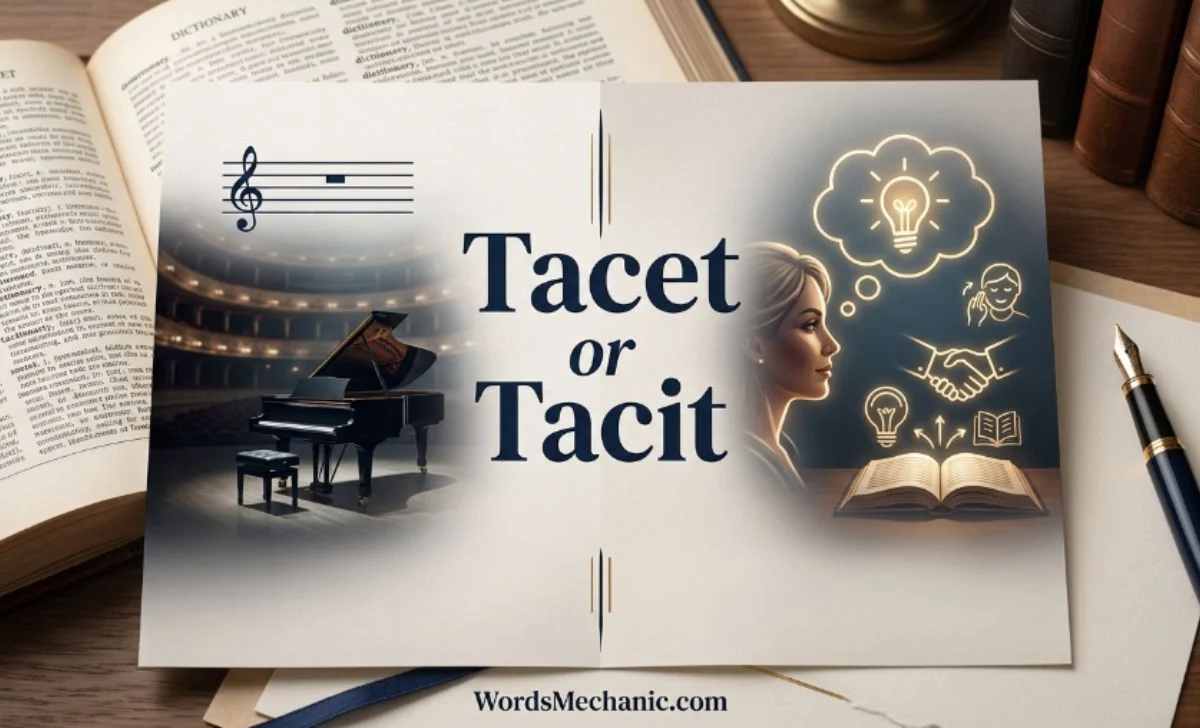
Have you ever seen two words that look almost identical but have completely different meanings?
Tacet and tacit are a perfect example. They differ by only one letter, but they belong to very different areas of English.
A business manager may give tacit approval without saying anything. However, a musician may see tacet written on a musical score to show that an instrument should remain silent.
This is why many people confuse these words. Both are connected to the idea of silence, but they are used in different situations.
The simple difference is:
- Tacit means unspoken, understood without being directly said.
- Tacet means silent or not played, especially in music.
In this guide, you will learn the meaning, pronunciation, examples, and correct usage of tacet vs tacit so you never mix them up again.
Quick Answer
Tacit and tacet are both correct words, but they have different meanings.
| Word | Meaning | Common Use |
|---|---|---|
| Tacit | Something understood without being spoken | Communication, agreements, opinions |
| Tacet | A direction meaning silent or not played | Music and musical scores |
The easiest way to remember them:
Tacit = silent meaning
Tacet = silent music
For example:
- The employee had tacit approval from the manager.
(The approval was understood but not directly spoken.) - The violin section was marked tacet in the final movement.
(The violinists should not play.)
Although both words relate to silence, they describe different kinds of silence.
What Does Tacit Mean?
Tacit is an adjective that describes something understood, accepted, or known without being directly expressed in words.
When something is tacit, people do not say it openly, but everyone understands it through actions, behavior, or circumstances.
Examples:
- There was a tacit agreement between the two companies.
- Her silence was taken as tacit approval.
- The team had a tacit understanding about their responsibilities.
In each example, the idea exists, but nobody clearly says it.
For example, if a manager does not object when an employee takes responsibility for a task, the employee may see that silence as tacit approval.
Common Uses of Tacit
Tacit Agreement
A tacit agreement is an understanding between people that is not written or spoken.
Example:
The neighbors had a tacit agreement to keep the area clean.
Nobody created a formal agreement, but both sides understood the expectation.
Tacit Approval
Tacit approval means showing agreement without directly saying “yes.”
Example:
The director’s silence was seen as tacit approval of the plan.
The director did not openly approve the idea, but their reaction suggested acceptance.
Tacit Knowledge
Tacit knowledge refers to knowledge gained through experience that is difficult to explain with words.
Examples include:
- A chef knowing how much seasoning to add without measuring.
- An experienced driver knowing when a car needs attention.
- A skilled musician understanding timing through practice.
This type of knowledge is learned through experience rather than written instructions.
Tacit Examples in Real Life
The word tacit appears in many everyday situations.
Workplace Example
The team had a tacit understanding that urgent emails should be answered quickly.
The rule was not officially written, but everyone understood it.
Relationship Example
They had a tacit agreement to support each other during difficult times.
The commitment was understood without being clearly stated.
Business Example
The company received tacit approval from investors after they continued funding the project.
The investors did not make a public statement, but their actions showed support.
What Does Tacet Mean?
Tacet is a musical term that means “it is silent” or “it remains silent.”
It is used in music notation to tell a performer or instrument section that they should not play during a specific part of a composition.
Unlike tacit, which is a common English adjective, tacet is mainly used in the world of music.
Examples:
- The trumpet section is tacet during the second movement.
- The composer marked the piano part as tacet.
- The flute remains tacet until the final section.
When a musician sees tacet on a score, it does not mean to play softly. It means do not play at all during that section.
Tacet in Music: How It Works
In an orchestra or musical performance, different instruments do not always play throughout the entire piece.
A composer may write tacet to tell a musician:
- remain silent,
- wait for another section,
- return later in the composition.
For example:
A symphony may include:
- Violins playing in the first movement
- Brass instruments marked tacet in one section
- Percussion returning later
The word helps musicians understand exactly when their part is silent.
Tacit vs Tacet: Why Are They Confused?
People often confuse tacit and tacet because:
- They look almost the same.
- Both words are connected to silence.
- Both come from the Latin root related to being silent.
However, their meanings developed in different directions:
- Tacit → silence in communication or understanding
- Tacet → silence in music performance
A simple memory trick:
TacIT = an idea is hidden but understood
TacET = an instrument is empty and silent
Tacit vs Tacet: Complete Difference
Although tacit and tacet look similar and are both connected with silence, they are used in completely different contexts.
Tacit is about unspoken communication. It describes something people understand without directly saying it.
Tacet is about musical silence. It tells a musician that an instrument or voice should not play during a particular section.
| Feature | Tacit | Tacet |
|---|---|---|
| Meaning | Understood without being spoken | Silent or not performed |
| Part of speech | Adjective | Musical term |
| Main field | Communication, business, relationships | Music and musical notation |
| Example | A tacit agreement | The piano is tacet |
The table shows the key difference: tacit describes hidden meaning, while tacet describes intentional silence in music.
If you are talking about people, agreements, or ideas, tacit is usually the correct word. If you are reading a musical score, tacet is the correct term.
Tacit and Tacet Pronunciation
Pronunciation is another reason these words can be confusing. They look similar but are not pronounced exactly the same.
Tacit Pronunciation
Tacit is pronounced:
TASS-it
/ˈtæsɪt/
Example:
- The manager gave tacit approval.
Tacet Pronunciation
Tacet is commonly pronounced:
TAH-chet
/ˈtɑːtʃeɪt/
Example:
- The violin section is tacet in this movement.
The pronunciation difference can help you identify which word someone means when speaking.
Common Mistakes to Avoid
Many learners mix up these words because both relate to silence. However, using one instead of the other can change the meaning of a sentence.
| Incorrect | Correct |
|---|---|
| ❌ She gave tacet approval. | ✅ She gave tacit approval. |
| ❌ The orchestra had a tacit section. | ✅ The orchestra had a tacet section. |
| ❌ His silence was a tacet agreement. | ✅ His silence was a tacit agreement. |
| ❌ The trumpet had a tacit marking. | ✅ The trumpet had a tacet marking. |
The easiest way to avoid these mistakes is to remember the context:
- Agreement, understanding, permission → tacit
- Music, instruments, performance → tacet
How to Use Tacit in a Sentence
Because tacit is an adjective, it describes a noun. It is commonly used with words such as:
- agreement
- approval
- understanding
- knowledge
- consent
- support
Examples:
- The employees had a tacit understanding of the new rules.
- The board gave tacit approval by taking no action.
- Years of experience gave her tacit knowledge of the industry.
- Their cooperation showed a tacit agreement.
In professional settings, tacit is often used when decisions or expectations exist without a formal announcement.
How to Use Tacet in a Sentence
Tacet is mostly used in music-related situations. It appears in musical scores, instructions, and discussions between performers.
Examples:
- The cello is tacet during the opening section.
- The composer marked the horn part tacet.
- The singer remains tacet until the final verse.
Unlike tacit, you will rarely hear tacet in normal conversation unless the topic is music.
Tacit Synonyms and Related Words
The best synonym for tacit depends on the situation.
| Tacit Meaning | Possible Synonyms |
|---|---|
| Not spoken | unspoken, unstated, silent |
| Understood without words | implicit, understood, assumed |
| Agreement without discussion | accepted, implied, recognized |
Examples:
- Tacit agreement → implicit agreement
- Tacit approval → silent approval
- Tacit knowledge → practical knowledge
However, synonyms are not always perfect replacements. For example, silent only means without sound, while tacit usually suggests that an idea or understanding exists.
Related Words and Concepts
Understanding related vocabulary makes the difference between these words easier.
Implicit
Something suggested but not directly stated.
Example:
- There was an implicit message in his response.
Unspoken
Something not said aloud.
Example:
- They shared an unspoken understanding.
Silence
The absence of sound or communication.
Example:
- The room was filled with silence.
Musical Rest
A period in music where a performer does not play.
Example:
- The composer included a long rest in the score.
These words connect with the idea of silence, but each has its own specific use.
FAQs
1. What is the difference between tacet and tacit?
Tacit means something is understood without being spoken. Tacet means silent, especially when a musician is instructed not to play.
2. Is tacet a real word?
Yes. Tacet is a real word, mainly used as a musical term. It tells performers that a section or instrument should remain silent.
3. What does tacit mean?
Tacit means understood, accepted, or known without being directly expressed in words.
4. What does tacet mean in music?
In music, tacet means that an instrument or singer should not perform during a particular section.
5. How do you pronounce tacit?
Tacit is pronounced TASS-it.
6. How do you pronounce tacet?
Tacet is commonly pronounced TAH-chet in musical contexts.
7. Is tacit an English word?
Yes. Tacit is a standard English adjective used in everyday and professional communication.
8. Can tacit and tacet be used interchangeably?
No. They have different meanings and should not replace each other.
9. What is another word for tacit?
Depending on the context, synonyms include implicit, unspoken, understood, unstated, and silent.
10. What is an example of tacit agreement?
A workplace rule that everyone follows without it being officially written down is an example of a tacit agreement.
Conclusion
The difference between tacit and tacet becomes simple once you remember their purpose. Tacit describes something understood without being spoken, such as a tacit agreement or tacit approval.
Tacet, on the other hand, is a musical term that tells performers to remain silent during a section of a composition.
Although both words are connected to the idea of silence, they belong to different areas of language.
Use tacit for communication and hidden meaning, and use tacet for music and performance instructions.