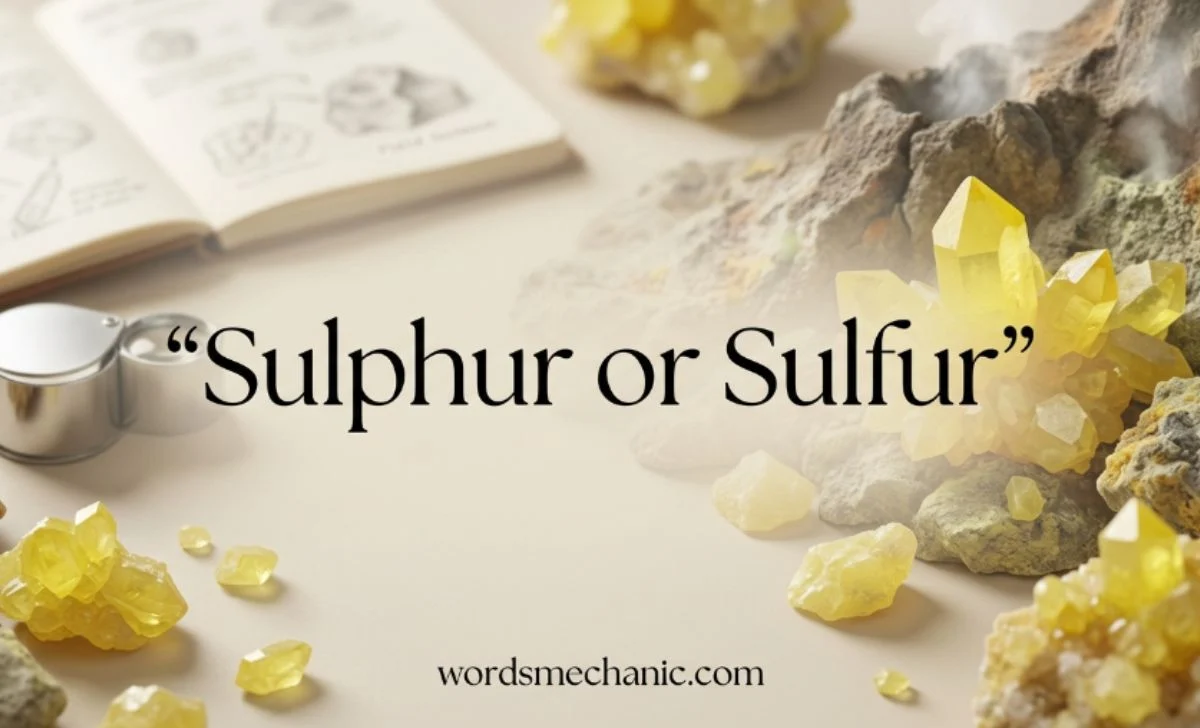
Have you ever seen sulphur in one article and sulfur in another and wondered which one is actually correct? You are not alone.
Both spellings are widely used, but they are not simply random variations. The choice often depends on the variety of English and the context in which the word is being used.
The good news is simple: sulphur and sulfur refer to the same chemical element. Sulphur is the traditional spelling associated with British English, while sulfur is preferred in American English and modern scientific nomenclature. IUPAC adopted sulfur as the spelling for element 16 in 1990.
So, whether you write “sulphur” or “sulfur,” you are talking about the same element. The important thing is to choose the spelling that fits your audience and writing style.
Quick Answer
Sulphur and sulfur are both correct spellings of the same chemical element. The main difference is regional usage.
Sulphur is the traditional spelling used mainly in British English, while sulfur is preferred in American English and is the spelling adopted by IUPAC for the element.
If you are writing for a US audience or in modern scientific writing, sulfur is usually the better choice. If you are following British English, sulphur is perfectly correct.
What Is the Difference Between Sulphur and Sulfur?
There is no difference in the chemical element itself. Sulphur and sulfur are simply two accepted spellings of the same word.
Sulfur is a nonmetallic chemical element with the symbol S and atomic number 16. It occurs naturally and is used in many areas, including agriculture, manufacturing, chemistry, and the production of sulfuric acid.
The spelling changes according to English variety. British English traditionally uses sulphur, while American English generally uses sulfur.
For example:
- British English: The soil contains sulphur.
- American English: The soil contains sulfur.
Both sentences are correct. The difference is similar to other British and American spelling differences, although the scientific community has increasingly favored the -f- form.
Is Sulfur the Correct Spelling?
Yes, sulfur is a correct spelling. It is not a simplified or informal version of sulphur. It is an established spelling used in American English and modern scientific terminology.
The International Union of Pure and Applied Chemistry, commonly known as IUPAC, adopted sulfur as the official spelling for the element in 1990.
This helped establish the -f- form as the preferred spelling in international chemical nomenclature.
However, this does not mean that sulphur suddenly became wrong. British English continues to use sulphur, and major English dictionaries recognize it as a valid spelling.
Therefore, saying that “sulphur is incorrect” would be misleading. It is better to say that sulfur is the preferred scientific and American spelling, while sulphur remains standard in British English.
Is Sulphur the British Spelling?
Yes. Sulphur is traditionally the British English spelling.
If you are writing in British English, you may naturally use words such as sulphur, sulphuric acid, and sulphur dioxide. These forms are familiar to British readers and remain accepted.
For example:
The farmer added sulphur to the soil.
A British reader would have no reason to consider sulphur a spelling mistake.
By contrast, American English generally uses sulfur:
The farmer added sulfur to the soil.
The important point is consistency. If your article follows British English, use the British forms throughout. If it follows American English, use the American forms throughout.
Is Sulfur the American Spelling?
Yes. Sulfur is the standard spelling in American English.
American dictionaries commonly use sulfur as the headword, and the spelling is especially common in American scientific and technical writing.
For example:
Sulfur is an essential element for many biological processes.
If your website targets readers in the United States, sulfur is generally the best spelling to use.
This also applies to related terms. American English commonly uses sulfur dioxide, sulfuric acid, and sulfur compounds, while British English often uses sulphur dioxide, sulphuric acid, and sulphur compounds.
Sulfur or Sulphur: Which One Does IUPAC Use?
For modern chemical nomenclature, sulfur is the preferred spelling.
IUPAC adopted sulfur for element 16 in 1990. This is why you will often see sulfur in chemistry textbooks, scientific papers, laboratory materials, and international chemical references.
The basic information is:
| Property | Sulfur |
|---|---|
| Chemical symbol | S |
| Atomic number | 16 |
| Element type | Nonmetal |
| IUPAC spelling | Sulfur |
| British spelling | Sulphur |
| American spelling | Sulfur |
The IUPAC preference is particularly useful if you are writing about chemistry rather than simply using the word in everyday English. Still, scientific preference does not make the traditional British spelling invalid.
When Did Sulphur Change to Sulfur?
There was not a simple moment when English speakers everywhere changed sulphur to sulfur.
The two spellings developed through different English spelling traditions, and both continued to be used. The major modern scientific change came when IUPAC adopted sulfur as the spelling for element 16 in 1990.
That decision made sulfur especially important in scientific and technical writing. However, British English continued to use sulphur in general writing.
So it is more accurate to say that sulfur became the preferred international scientific spelling, rather than saying that sulphur was completely replaced.
Is Sulfur Spelled With an F or PH?
The answer depends on which spelling you are using.
Sulfur is spelled with f:
S-U-L-F-U-R
Sulphur is spelled with ph:
S-U-L-P-H-U-R
Both forms are recognized. If you are using American English or following IUPAC scientific terminology, choose sulfur. If you are following traditional British English, sulphur is appropriate.
A simple memory trick is to remember:
American/scientific → sulfur
British/traditional → sulphur
Sulphur Atomic Number and Symbol
Sulfur has the atomic number 16 and the chemical symbol S.
The atomic number tells us that a neutral sulfur atom has 16 protons in its nucleus. Sulfur belongs to the nonmetal group of elements and occurs naturally in several forms.
The spelling does not affect the chemical information. Whether a source says sulphur or sulfur, the element still has the symbol S and atomic number 16.
For example, both of these statements communicate the same fact:
Sulfur has an atomic number of 16.
Sulphur has an atomic number of 16.
Only the spelling differs.
What Is the Sulphur Formula?
If you are searching for the sulphur formula, it is important to distinguish the element from sulfur-containing compounds.
The chemical symbol for sulfur is S. Elemental sulfur can commonly occur as S₈, a molecule containing eight sulfur atoms.
However, sulfur also forms many compounds. Some familiar examples include:
- S — chemical symbol for sulfur
- S₈ — a common molecular form of elemental sulfur
- SO₂ — sulfur dioxide
- H₂SO₄ — sulfuric acid
- H₂S — hydrogen sulfide
The spelling may be sulphur or sulfur, but chemical formulas remain unchanged.
What Are the Uses of Sulfur?
Sulfur has many practical uses, which is one reason the element is important in industry and agriculture.
One of its major uses is the production of sulfuric acid, an important industrial chemical. Sulfur is also used in fertilizers and soil treatments because plants need sulfur as a nutrient.
Another major use is in the production of rubber. Sulfur helps create stronger and more durable rubber through a process known as vulcanization.
Sulfur compounds are also used in chemical manufacturing, petroleum processing, agriculture, pharmaceuticals, and the production of various industrial materials.
Some common uses of sulfur include:
- Producing sulfuric acid
- Making fertilizers
- Treating sulfur-deficient soil
- Vulcanizing rubber
- Producing chemicals
- Manufacturing some pharmaceuticals
- Producing fungicides
- Producing pesticides
- Processing petroleum
- Making other sulfur-containing compounds
The exact application depends on whether elemental sulfur or a particular sulfur compound is being used.
What Is Sulphur Dioxide?
Sulphur dioxide is the British spelling, while sulfur dioxide is the American spelling. Both refer to the same chemical compound.
Its chemical formula is SO₂. It is a gas with a strong, irritating odor and can be produced through natural processes as well as human activities such as burning sulfur-containing fuels.
The two spelling forms are:
British English: sulphur dioxide
American English: sulfur dioxide
This is a good example of why knowing the regional spelling matters. The word sulphur does not describe a different chemical from sulfur. The same applies to their related compounds.
Does Sulphur Have a Smell?
Pure elemental sulfur is not responsible for the classic rotten-egg smell that people often associate with sulfur.
That smell is strongly associated with certain sulfur-containing compounds, especially hydrogen sulfide. Hydrogen sulfide has a distinctive rotten-egg odor and can be hazardous at sufficient concentrations.
So, saying “sulfur smells like rotten eggs” is too broad. Sulfur is the element, while different sulfur compounds can have very different smells.
This distinction is useful when discussing questions such as can humans smell sulfur? Humans can detect certain sulfur compounds by their odors, but that does not mean every form of sulfur has a strong smell.
What Is Sulfur Called in the Bible?
The traditional English word associated with sulfur in the Bible is brimstone.
The expression “fire and brimstone” is especially well known. In older English usage, brimstone referred to sulfur.
This is why someone reading an older religious or literary text may encounter brimstone instead of the modern word sulfur. The terms are closely connected, but brimstone is now mostly used in historical, religious, or literary contexts.
Is Brimstone Just Sulfur?
Yes. Brimstone is an old name for sulfur.
The word appears frequently in older English and is especially familiar from biblical expressions such as “fire and brimstone.”
Today, however, scientists normally use sulfur rather than brimstone. If you encounter brimstone in a historical or religious text, it generally refers to sulfur.
Sulphur or Sulfur in Canada
Canadian English can show influence from both British and American spelling conventions, so you may encounter sulfur and sulphur.
For scientific writing, sulfur is a practical choice because it follows modern international chemical nomenclature. However, the choice can also depend on the publication’s house style.
If you are writing for a broad Canadian audience, consistency matters more than trying to force one spelling into every context.
Common Mistakes With Sulphur and Sulfur
One common mistake is assuming that one spelling must be completely wrong.
For example:
Sulphur is always incorrect.
That statement is not accurate. Sulphur remains a standard British spelling.
Another mistake is mixing spelling systems without a reason. A writer might use sulfur in one paragraph and sulphuric acid in the next.
If the article is written in American English, it is usually better to use sulfuric acid consistently.
Similarly, a British English article would normally maintain forms such as sulphur, sulphuric acid, and sulphur dioxide.
The best approach is simple: choose your regional style and stay consistent.
Sulphur or Sulfur: Which Should You Use?
If you are writing for an American audience, use sulfur.
If you are writing in British English, sulphur is a natural and accepted choice.
If you are writing about chemistry in a scientific context, sulfur is generally preferable because it follows the IUPAC spelling for the element.
For example:
US: Sulfur is present in the sample.
UK: Sulphur is present in the sample.
Neither sentence is wrong. Your audience and style guide determine which version is better.
How to Remember Sulfur vs. Sulphur
The easiest way to remember the difference is to connect sulfur with American and scientific writing.
Think:
Sulfur = US + IUPAC
And:
Sulphur = UK/traditional
This simple distinction can help you avoid second-guessing yourself when writing about the element.
You do not need to memorize two different meanings because there are not two meanings. Sulfur and sulphur are simply spelling variants of the same word.
FAQs
Are sulfur and sulphur the same?
Yes. Sulfur and sulphur are different spellings of the same chemical element. They have the same chemical symbol, S, and atomic number, 16. The main difference is regional and stylistic.
Is sulfur the correct spelling?
Yes. Sulfur is a correct spelling and is preferred in American English and modern IUPAC chemical nomenclature. Sulphur is also correct in British English.
When did sulphur change to sulfur?
There was no universal change in everyday English. However, IUPAC adopted sulfur as the spelling for element 16 in 1990, making it the preferred form in modern chemical nomenclature.
Is sulfur spelled with an F or PH?
Sulfur is spelled with an f, while sulphur uses ph. Both spellings are accepted, although sulfur is preferred in American and modern scientific usage.
Is sulfur toxic to humans?
The safety of sulfur depends on the particular substance and exposure. Elemental sulfur and sulfur compounds do not all have the same effects. Some sulfur compounds, such as sulfur dioxide and hydrogen sulfide, can be hazardous.
What is the old name for sulfur?
Brimstone is an old English name for sulfur. It is most familiar today from historical and biblical expressions such as “fire and brimstone.”
Is sulfur the smelliest element?
No. There is no reliable scientific ranking that makes sulfur the “smelliest element.” The unpleasant odors associated with sulfur are usually caused by particular sulfur-containing compounds.
What is sulfur called in the Bible?
In traditional English Bible translations, sulfur is often called brimstone. The expression “fire and brimstone” is the best-known example.
Is brimstone just sulfur?
Yes. Brimstone is an old name for sulfur. The term is now mainly used in religious, historical, and literary contexts.
What are 10 uses of sulfur?
Sulfur is used to make sulfuric acid, fertilizers, soil treatments, rubber, chemicals, pharmaceuticals, fungicides, pesticides, petroleum products, and other sulfur-containing materials.
Does sulphur have a smell?
Pure elemental sulfur does not have the classic rotten-egg smell commonly associated with sulfur. That odor is mainly linked to certain sulfur-containing compounds, particularly hydrogen sulfide.
How is sulfur spelled in Canada?
Both sulfur and sulphur may be encountered in Canadian English. In scientific contexts, sulfur is a strong choice because it follows modern international chemical nomenclature.
Can humans smell sulfur?
Humans can smell certain sulfur-containing compounds, sometimes at very low concentrations. However, it is not accurate to assume that every form of elemental sulfur has a strong smell.
Final Verdict
So, sulphur or sulfur? Both are correct. Sulphur is the traditional British English spelling, while sulfur is preferred in American English and is the spelling used by IUPAC for the chemical element.
If your audience is American, choose sulfur. If you are following British English, sulphur is perfectly acceptable.
For modern scientific writing, sulfur is usually the safest choice because it follows international chemical nomenclature.
The key point is that the two spellings do not represent different elements. They are simply different spellings of the same word.