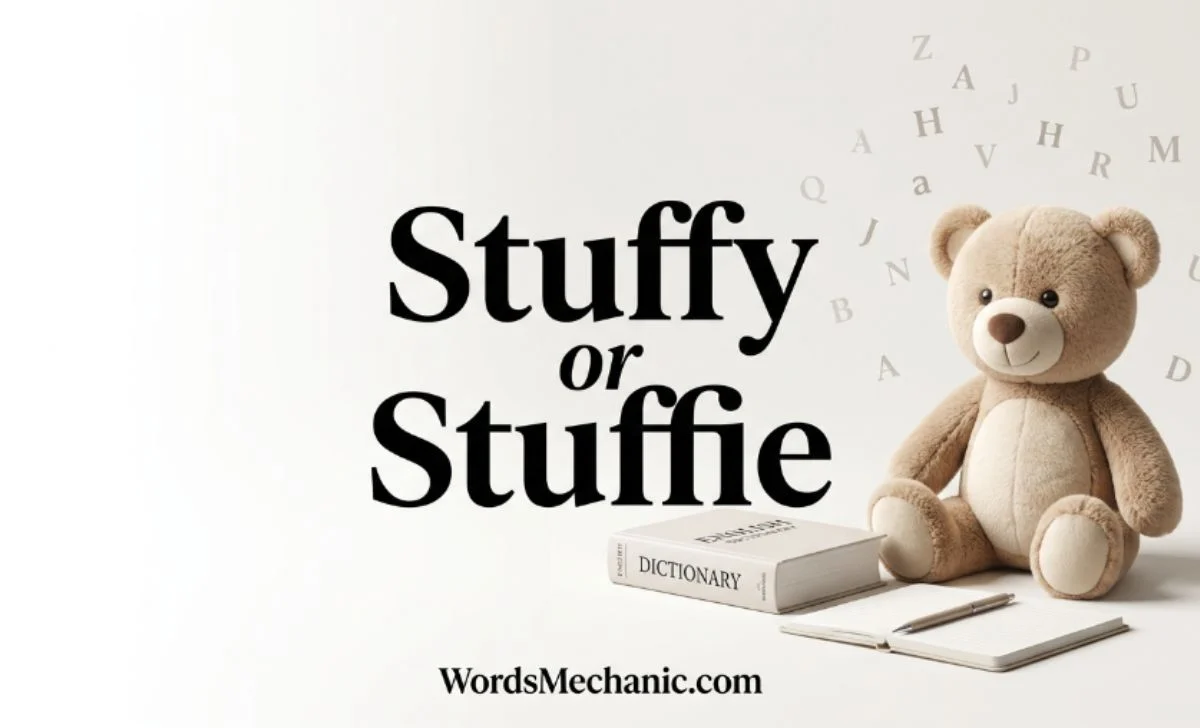
Have you ever wondered whether a soft teddy bear is a stuffy or stuffie? These words look almost the same, but they are used in different ways.
Stuffy is a standard English adjective. It can describe a room with little fresh air, a blocked nose, or someone who seems too formal or old-fashioned.
Stuffie, on the other hand, is an informal word for a stuffed animal or plush toy.
The difference is small in spelling but important in meaning. If you are talking about a teddy bear, stuffie is the clearer choice.
If you are talking about a room, nose, or formal personality, stuffy is the right word. This guide explains both words with simple definitions, examples, pronunciation, common mistakes, and useful real-world contexts.
Quick Answer
Stuffy and stuffie are both used in English, but they do not normally mean the same thing.
- Stuffy = lacking fresh air, congested, or overly formal.
- Stuffie = an informal word for a stuffed animal or plush toy.
For example:
The bedroom feels stuffy.
My daughter sleeps with her favorite stuffie.
So, if you mean a teddy bear or plush animal, stuffie is the better choice. If you mean a stuffy nose or stuffy room, use stuffy.
Stuffy vs. Stuffie at a Glance
| Word | Part of speech | Main meaning | Example |
|---|---|---|---|
| stuffy | Adjective | Airless, congested, or overly formal | This room feels stuffy. |
| stuffie | Informal noun | A stuffed animal or plush toy | She took her stuffie to bed. |
The easiest memory trick is:
Stuffy = stuffy room or stuffy nose.
Stuffie = stuffed toy.
Although the words are closely related in appearance, their roles in a sentence are different.
What Does “Stuffie” Mean?
Stuffie is an informal and affectionate word for a stuffed animal, plush toy, or similar soft toy. It is especially common in casual conversations involving children, families, and people who collect plush toys.
A stuffie might be a:
- teddy bear
- stuffed rabbit
- plush dog
- stuffed cat
- soft dinosaur
- plush character
- stuffed doll
For example:
My son takes his favorite stuffie everywhere.
She has a small stuffie beside her pillow.
That brown bear was my childhood stuffie.
The word has a warm, playful tone. It is not usually the best choice for formal writing. In a formal article, stuffed animal or plush toy may be more appropriate.
Is “Stuffie” a Real Word?
Yes. Stuffie is an informal English word used for a stuffed toy or stuffed animal. It is a casual term rather than a formal name for a specific type of toy.
You may also see the spelling stuffie in conversations, social media posts, product descriptions, and discussions about plush toys.
What Does “Stuffy” Mean?
Stuffy is a standard English adjective with several meanings. Its meaning depends on the context.
Stuffy Meaning: Lack of Fresh Air
A room, office, or building can be called stuffy when the air feels warm, closed, stale, or poorly ventilated.
For example:
This classroom feels stuffy.
The office became stuffy after the windows were closed.
It is too stuffy in here. Can we open a window?
In this use, stuffy describes the environment rather than a person.
Stuffy Meaning: A Blocked Nose
Stuffy is also common when talking about nasal congestion.
I have a stuffy nose.
My nose feels stuffy because of my allergies.
Here, stuffy means that the nose feels blocked or congested.
Stuffy Meaning: Too Formal or Old-Fashioned
A person, organization, place, or atmosphere can also be called stuffy when it seems excessively formal, serious, traditional, or unwilling to accept change.
For example:
The club has a stuffy atmosphere.
He thinks the company is too stuffy.
This meaning is often negative because it suggests a lack of warmth, flexibility, or informality.
Is a Stuffy a Doll or Stuffed Animal?
If someone uses stuffy informally to refer to a stuffed toy, the meaning may be clear from context. However, stuffie is the clearer spelling when you specifically mean a plush toy.
For example:
My daughter loves her stuffie.
This clearly points to a stuffed animal or plush toy.
By contrast:
The room is stuffy.
Here, there is no connection to toys. The word describes the air in the room.
If you want to avoid ambiguity, use stuffie, stuffed animal, or plush toy for the toy meaning.
Stuffy Meaning for Kids
When children or parents use stuffie, they usually mean a favorite stuffed animal or soft toy.
A stuffie can be part of a child’s:
- bedtime routine
- pretend play
- travel routine
- comfort routine
- toy collection
For example:
Where is your stuffie?
My stuffie is sleeping beside me.
She brought her stuffie on the family trip.
The word is popular because it sounds friendly and simple. However, stuffed animal is still the clearer term in formal or educational writing.
Why Do People Get Attached to Stuffies?
A favorite stuffed animal can become more than just a toy. Children may use familiar soft toys as comfort objects during bedtime, travel, separation, or other changes in routine.
For some children, a favorite toy becomes part of a familiar routine:
The child takes the same stuffie to bed every night.
Adults can also keep plush toys for sentimental reasons, collecting, decoration, fandom, or nostalgia. Therefore, owning a stuffie is not limited to children.
It is better to describe these uses without assuming that every child or adult has the same emotional response to a stuffed toy.
Can Adults Have Stuffies?
Absolutely. Stuffie is not a word that only applies to children.
An adult may keep a stuffie because it is:
- a childhood keepsake
- a collectible
- a favorite character
- a gift
- a decorative item
- a sentimental object
For example:
She still keeps her childhood stuffie on her bookshelf.
He collects plushies from his favorite video games.
In casual conversation, both stuffie and plushie can sound natural when talking about soft collectible toys.
Stuffie vs. Plushie vs. Plushy
These words are related, but they are not identical.
Stuffie
Stuffie is an informal word for a stuffed animal or stuffed toy.
My niece got a cute stuffie for her birthday.
Plushie
Plushie is another informal term for a plush toy, often used for cute character toys, animals, and collectibles.
She has a collection of anime plushies.
Plushy
Plushy is less straightforward. It can describe something soft or plush-like, and it may also appear informally in toy-related contexts.
If you are naming a soft toy, stuffie or plushie is usually clearer.
Stuffy or Stuffie Nose?
The correct phrase is stuffy nose.
I have a stuffy nose.
She woke up with a stuffy nose.
Here, stuffy is an adjective describing nasal congestion.
Stuffie nose is not the standard phrase.
This is one of the most useful distinctions to remember:
stuffy nose = blocked or congested nose
stuffie = stuffed toy
What Is Inside a Stuffed Toy?
A stuffed toy normally has a soft outer covering and an internal filling. The exact materials vary by toy.
Common materials can include:
- polyester fiberfill
- cotton
- fleece
- synthetic plush fabric
- other soft textile materials
Some toys may also contain plastic eyes, embroidered details, beads, or other components.
For young children, it is important to follow the manufacturer’s age recommendations and check toys for loose parts or damaged seams.
What Does “Stuffy” Mean in Slang?
In informal English, stuffy can describe a person, place, or situation that feels too formal, serious, conventional, or old-fashioned.
For example:
The hotel seemed a little stuffy.
He has a stuffy attitude about modern music.
This meaning is different from the physical meaning of stuffy in stuffy room.
It also has nothing to do with a stuffie, which is a stuffed toy.
What Is a “Stuffie” Food?
In some regional food contexts, stuffie is an informal name for a stuffed clam. The term is particularly associated with regional seafood usage in parts of the United States.
A food stuffie may contain a stuffing made with ingredients such as breadcrumbs, herbs, seasonings, and seafood.
So context matters:
My child wants her favorite stuffie.
Here, the word refers to a plush toy.
The restaurant serves seafood stuffies.
Here, it refers to a food.
This is why surrounding words are important when interpreting informal vocabulary.
What Are Dead Stuffed Animals Called?
The phrase stuffed animal usually means a toy. It does not normally mean a real dead animal.
A real animal preserved for display through taxidermy is called a taxidermied animal or a taxidermy mount.
Compare:
The child hugged her stuffed animal.
This means a toy.
The museum displayed a taxidermy mount.
This refers to a preserved real animal.
These are completely different uses, even though both can involve the idea of something being “stuffed.”
Stuffy or Stuffie: Common Mistakes
Mistake 1: Using “stuffie” for a nose
Incorrect:
I have a stuffie nose.
Correct:
I have a stuffy nose.
Mistake 2: Using “stuffy” for a toy
If you specifically mean a plush toy, stuffie is clearer:
My child loves her stuffie.
Mistake 3: Treating the words as interchangeable
The two words may sound similar, but their meanings are different.
- stuffy → adjective
- stuffie → informal noun
Mistake 4: Using “stuffie” in formal writing
In formal writing, stuffed animal or plush toy is often a better choice.
For example:
The child brought her stuffed animal to school.
This is more neutral than:
The child brought her stuffie to school.
Stuffy or Stuffie Examples
Here are some natural examples from everyday English:
Stuffy:
- The room feels stuffy.
- I have a stuffy nose.
- The office became stuffy.
- The meeting had a stuffy atmosphere.
- He seems a little stuffy.
Stuffie:
- My daughter loves her stuffie.
- He sleeps with his favorite stuffie.
- She packed her stuffie for the trip.
- That teddy bear is my favorite stuffie.
- The store has hundreds of cute stuffies.
These examples make the difference easy to see.
How to Choose the Right Word
Use stuffy when you are describing:
- a room
- air
- a nose
- an atmosphere
- a person
- a formal attitude
Use stuffie when you are talking about:
- a stuffed animal
- a plush toy
- a soft toy
- a child’s comfort toy
- a plush collectible
If you are writing for a formal audience, consider replacing stuffie with stuffed animal or plush toy.
Stuffy or Stuffie: Pronunciation
The words are pronounced very similarly, which is one reason people confuse them.
Stuffy is commonly pronounced like STUH-fee.
Stuffie is commonly pronounced in a very similar way.
The difference is easier to notice in writing than in speech. Context usually tells the listener which meaning is intended.
Stuffy or Stuffie: Quick Practice
Choose the correct word in each sentence.
1. The classroom feels ___ because all the windows are closed.
Answer: stuffy
2. My daughter takes her favorite ___ to bed.
Answer: stuffie
3. I woke up with a ___ nose.
Answer: stuffy
4. He collects cute plush ___ from different games.
Answer: stuffies
5. The old club had a very ___ atmosphere.
Answer: stuffy
These examples reinforce the main rule: stuffy describes; stuffie names a toy.
Frequently Asked Questions
1. Is it spelled stuffy or stuffie?
Both forms are used, but they have different meanings. Stuffy is the standard adjective for something airless, congested, or overly formal. Stuffie is an informal word for a stuffed animal or plush toy.
2. What does stuffy mean in slang?
In informal English, stuffy can describe someone or something that seems too formal, serious, traditional, or old-fashioned.
3. Is a stuffy a doll?
Stuffie can refer to a stuffed doll or plush toy. However, stuffed animal or plush toy is clearer in formal writing.
4. What is in a stuffed toy?
A stuffed toy usually has a soft outer material and an internal filling. Polyester fiberfill and other soft materials are commonly used, depending on the toy.
5. Why is Gen Z so obsessed with plushies?
Plushies are popular with some younger people as collectibles, character merchandise, decorations, and comfort objects. However, it is too broad to assume that all Gen Z people share the same interest.
6. Is it stuffie or stuffy nose?
The standard phrase is stuffy nose. It means a blocked or congested nose. Stuffie refers to a stuffed toy.
7. What is stuffy for kids?
When talking about toys, stuffie usually means a stuffed animal or plush toy that a child likes, plays with, or uses as a comfort object.
8. What is a stuffy doll used for?
A stuffed doll can be used for imaginative play, comfort, companionship, collecting, or bedtime routines.
9. Can adults have stuffies?
Yes. Adults may keep stuffies as collectibles, decorations, childhood keepsakes, gifts, or sentimental objects.
Conclusion
The difference between stuffy and stuffie becomes simple once you connect each word with its meaning.
Stuffy is an adjective used for things such as a room with poor airflow, a congested nose, or a person who seems too formal or old-fashioned. Stuffie is an informal noun for a stuffed animal, plush toy, or similar soft toy.
So, remember the easiest rule: a stuffy room, a stuffy nose, but a stuffie teddy bear. If you are writing formally, use stuffed animal or plush toy instead of stuffie.
Choosing the right word makes your meaning clear and prevents a small spelling difference from creating a completely different message.