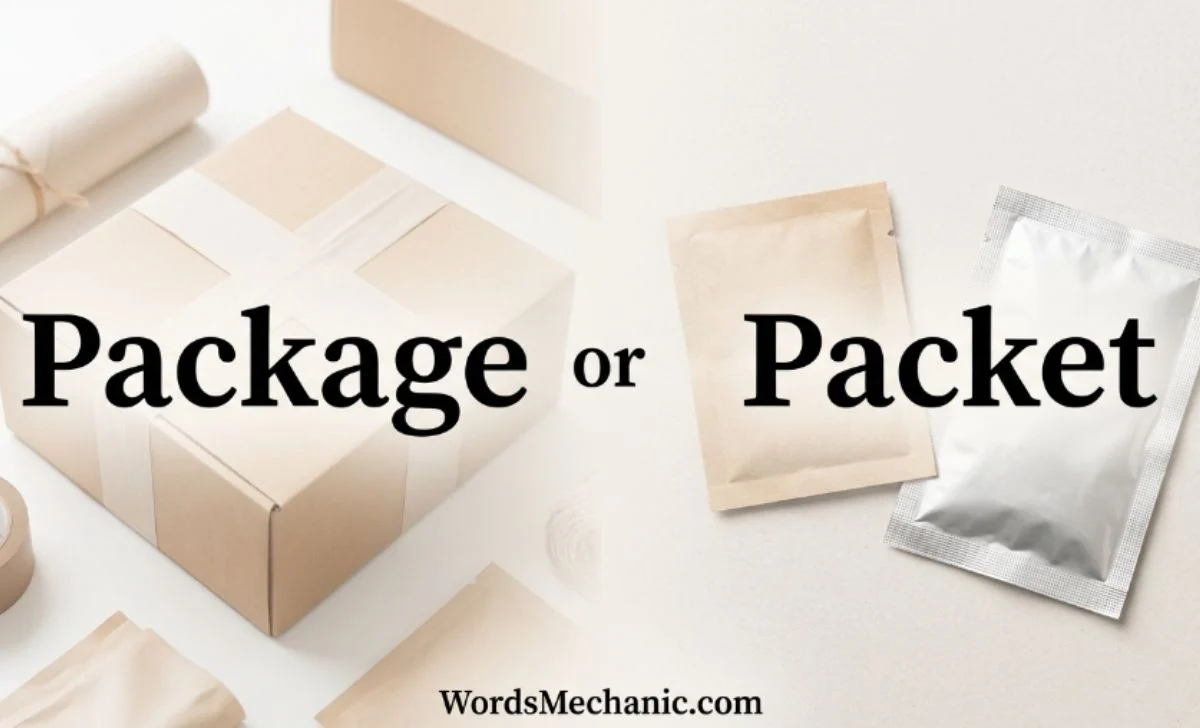
Have you ever wondered whether something should be called a package or a packet? The two words are closely related, but they are not always interchangeable.
A delivery at your door is usually a package, while a small amount of food, seeds, or another item may come in a packet. The choice can also depend on the type of English you are using.
The distinction becomes even more interesting when parcel enters the picture. In American English, package is common for mailed items, while British English often prefers parcel. Meanwhile, packet is widely used for small packaged items.
So, is a packet a package? Sometimes it can be, but the words emphasize different things.
This guide explains package or packet meaning, their everyday uses, their differences in American and British English, and even how packet is used in networking.
Quick Answer
Package generally refers to something that has been wrapped, boxed, or prepared for carrying, shipping, or delivery. It can also describe a collection of products or services offered together.
Packet usually refers to a small container or quantity of something, such as food, seeds, documents, or other lightweight items. In computing, however, packet has a specific technical meaning.
For example:
- My package arrived this morning.
- She opened a packet of biscuits.
- He sent a package of documents to the office.
- The computer transmitted a data packet.
Therefore, package is the broader word, while packet often suggests a smaller quantity or container. However, size alone does not determine the choice in every situation.
What Does Package Mean?
A package is something that has been wrapped, boxed, or otherwise prepared as a single item for storage, transport, or delivery. It can contain one object or several things grouped together.
For instance, a box ordered from an online store can be called a package. The word is especially common when discussing deliveries:
The courier left my package at the front door.
However, package has uses beyond physical objects. It can describe a collection of related things offered together, such as a travel package, software package, insurance package, or salary package.
The word can therefore refer either to a physical item or to a group of related products, services, or benefits.
What Does Packet Mean?
A packet usually means a small package, container, or quantity of something. It is commonly used when the contents are relatively small or when they are supplied in a convenient individual portion.
For example:
- a packet of tea
- a packet of seeds
- a packet of biscuits
- a packet of sugar
- a packet of documents
The exact size is not fixed. A packet does not have to be tiny, and a package does not always have to be large. Instead, packet often carries the idea of a small, contained quantity.
There is also an important technical meaning. In computer networking, a packet is a formatted unit of data transmitted across a network. This meaning is completely different from a packet of food or documents.
Package or Packet of Documents?
Both expressions can be correct, but they can suggest slightly different things.
A package of documents can mean a collection of papers grouped together, particularly when they are being sent, delivered, or formally submitted.
For example:
The company sent a package of documents to the client.
A packet of documents usually suggests a smaller, organized collection of papers.
For example:
Please attach a packet of documents to the application.
In formal or administrative contexts, packet may emphasize a prepared set of papers, while package can sound broader and may suggest something being transported or delivered.
So, when asking “package or packet of documents?”, consider the context rather than relying only on size.
Package vs Packet: Main Difference
The clearest distinction is their typical use.
| Word | Typical Meaning | Common Examples |
|---|---|---|
| Package | A wrapped, boxed, or grouped item | package delivery, gift package |
| Packet | A small container or quantity | packet of seeds, packet of biscuits |
| Parcel | An item prepared for mailing or delivery | postal parcel |
| Pack | A group or quantity of similar items | pack of cards, pack of batteries |
A package often focuses on the item as something prepared for transport, storage, or sale. A packet often focuses on a smaller contained quantity.
However, these are tendencies rather than strict rules. Context matters, and native speakers may choose different terms depending on the country and the particular item.
Package vs Parcel: US English and USPS
If you are looking at package vs parcel USPS, the distinction is mainly about terminology used in American shipping.
In American English, package is the everyday word people commonly use for an item being shipped or delivered.
For example:
I’m waiting for a package from USPS.
The word parcel is also understood in American English, but it is less common in ordinary conversation than package.
In British English, the situation is different. Parcel is the usual everyday word for a mailed item:
The parcel arrived this afternoon.
This does not mean that package is incorrect in British English. It simply means that parcel is often the more natural choice for postal deliveries.
Therefore, if your context is US shipping, package is generally the safest everyday choice.
Package or Packet in British and American English
There is no British-versus-American spelling difference between these two words. Package is spelled package, and packet is spelled packet in both varieties.
The difference is mainly about usage.
In American English, people commonly say:
I got a package in the mail.
For small food items, American speakers may prefer bag, pack, or another specific container word depending on the product.
In British English, packet is particularly common for small packaged foods:
I bought a packet of crisps.
British speakers also commonly use parcel for something sent through the mail.
So the spelling stays the same, but the preferred word can change with the context and variety of English.
Is a Packet the Same as a Package?
Not exactly. A packet can be considered a type of package in some contexts because both words can refer to something containing or holding items.
However, the two words are not interchangeable in every sentence.
For example, packet of seeds sounds natural because it refers to a small container holding seeds. On the other hand, package of furniture is more natural when referring to a larger shipment or collection of furniture.
There are also fixed expressions that make substitution sound unnatural. For example, package deal is standard, while packet deal is not.
Likewise, data packet is the established networking term. Calling it a data package would change the technical terminology.
Package or Packet Reddit: What Does Usage Show?
Discussions on Reddit and other online communities often show why these words can be confusing. Speakers from different countries may choose different terms for the same physical object.
One person may naturally say package, while another may say packet, pack, or parcel. This is particularly noticeable when people from American and British English backgrounds discuss food packaging or mail.
Online discussions are useful for seeing real-world language preferences, but they should not be treated as the final authority on standard English. Regional habits, product names, and personal preferences can all influence the word someone chooses.
For formal writing, it is better to follow the usage appropriate to your audience and the specific context.
Packet vs Package in Networking
The phrase packet vs package network can be confusing because packet has a specialized meaning in computer networking.
A network packet is a small formatted unit of data sent from one device to another across a network. When information travels over the internet, it is commonly broken into packets so that the data can be transmitted efficiently and reassembled at its destination.
For example:
The router forwarded the data packet to another device.
In this context, packet is the correct technical term. Package does not normally replace it.
The word package can still appear in computing, but it has a different meaning. A software package, for example, is a collection of software files or components distributed together.
So:
Network packet = a unit of transmitted data.
Software package = a collection of software components.
The distinction is important because the two words have different technical meanings in computing.
Pack and Parcel Meaning
The words pack, packet, package, and parcel are related, but each has its own typical uses.
A pack is generally a group or quantity of similar things. For example, you can buy a pack of batteries or a pack of cards.
A packet is usually a small container or quantity, such as a packet of sugar or seeds.
A package can refer to something wrapped or boxed for transport, as well as a collection of products or services.
A parcel commonly refers to something prepared for mailing or delivery, especially in British English.
For example:
- a pack of cards
- a packet of seeds
- a package from an online store
- a parcel delivered by post
These meanings overlap, but the usual collocations help you choose the most natural word.
Common Mistakes with Package and Packet
One common mistake is assuming that packet always means something extremely small. Size can influence the choice, but it is not a strict grammatical rule.
Another mistake is using packet when talking about a postal delivery in American English. Packet can be understood, but package is usually more natural for an ordinary mailed item.
A third mistake is replacing packet with package in established expressions. For example, packet of seeds and packet of sugar are natural combinations, while package of sugar may suggest a different type or quantity of packaging.
Finally, avoid confusing network packet with software package. These are established technical terms with different meanings.
Examples of Package and Packet in Sentences
Here are some natural examples that show how the words work in context:
Package:
The delivery driver brought my package this afternoon.
The company offers a complete travel package.
She prepared a package of documents for the meeting.
Packet:
He opened a packet of biscuits.
The gardener bought a packet of flower seeds.
Please include a packet of documents with the application.
Parcel:
The parcel arrived at the London address yesterday.
Network packet:
The router received a network packet containing the requested data.
These examples show that the surrounding context is often more useful than a simple “big versus small” rule.
Package vs Packet: Which Word Should You Use?
Choose package when you are talking about a wrapped or boxed item, especially something being shipped or delivered. It is also the right choice for many expressions involving groups of services or products.
Choose packet when you mean a small container or quantity, particularly with things such as food, seeds, sugar, or documents. Use it as well when discussing a network packet.
Choose parcel when referring to a mailed item in contexts where British English is preferred.
If you are unsure, look at the noun that follows the word. Natural combinations such as package delivery, packet of seeds, packet of biscuits, and network packet can make the choice much easier.
FAQs
1. Is it pack or packet?
Use pack for a group or quantity of items and packet for a small container or quantity, depending on the context.
2. How do I spell packet?
The correct spelling is packet, with the letters p-a-c-k-e-t.
3. Are packet and package the same?
Not always; a packet is usually a small container or quantity, while a package is a broader term for something wrapped, boxed, shipped, or grouped together.
4. What is another word for “packet”?
Depending on the context, alternatives include pack, sachet, pouch, bag, parcel, or container, although they are not interchangeable in every situation.
5. What is an example of a packet?
A packet of seeds, packet of biscuits, packet of sugar, or packet of documents is a common example.
6. What is in a packet?
A packet can contain many things, including food, seeds, documents, small products, or data when packet is being used in computer networking.
7. How do I spell packaging?
The correct spelling is packaging, meaning the materials or process used to wrap, protect, or present a product.
8. What is another word for “package”?
Depending on the context, possible alternatives include parcel, pack, bundle, container, or shipment.
9. What do you call a package?
A package may also be called a parcel, pack, bundle, or shipment, depending on what it contains and how it is being used.
Conclusion
Although package and packet are closely related, they are not interchangeable in every situation.
A package is a broad term for something wrapped, boxed, shipped, or offered as a collection, while a packet usually refers to a smaller container or quantity.
The choice can also depend on regional usage, especially when talking about mail: American English commonly uses package, whereas British English often prefers parcel.
Context matters even more in specialized fields. A network packet is a unit of transmitted data, while a software package is a collection of software components.
Once you learn these common patterns, choosing between package and packet becomes much easier.
When in doubt, focus on the object, the context, and the variety of English your audience uses.