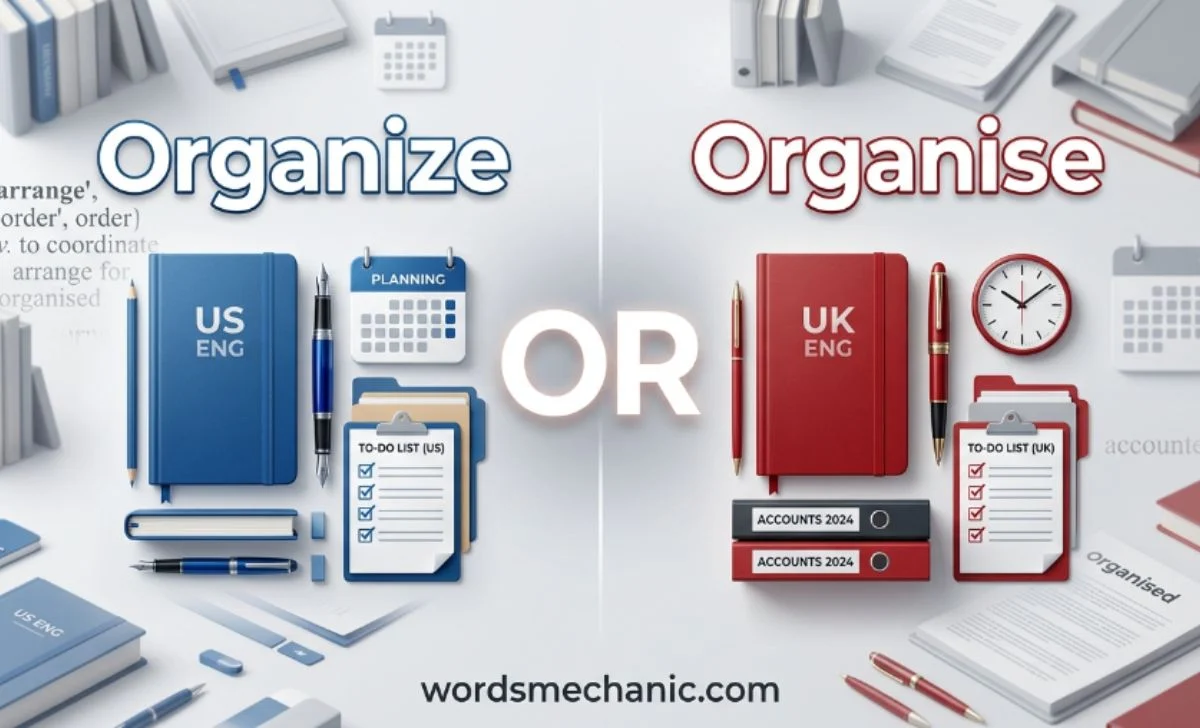
Have you ever paused while writing because you were unsure whether to use organize or organise? Millions of people search this spelling difference every year because both forms appear in books, websites, emails, and professional documents.
The confusion comes from regional English, not grammar. Organize is the preferred spelling in American English, while organise is commonly used in British English and many Commonwealth countries.
Both spellings have the same meaning and are grammatically correct. Choosing the right version depends on your audience and the writing style you follow.
This guide explains the meaning, spelling differences, grammar rules, examples, and practical usage tips.
By the end, you will know exactly which spelling to use with confidence in every writing situation.
Organize or Organise – Quick Answer
Both organize and organise are correct spellings. They have the same pronunciation, meaning, and grammar. The only difference is the variety of English.
- Organize is the preferred spelling in American English.
- Organise is the preferred spelling in British English.
Choose the spelling that matches your audience and use it consistently throughout your document.
For example:
- We need to organize the meeting before Friday. (American English)
- We need to organise the meeting before Friday. (British English)
Correct Example
| English Variety | Sentence |
|---|---|
| American English | She will organize the office today. |
| American English | They organized the event perfectly. |
| British English | She will organise the office today. |
| British English | They organised the event perfectly. |
Incorrect Example
| Incorrect Sentence | Reason |
|---|---|
| We will organize the event and organise the guest list. | American and British spellings are mixed in one sentence. |
| The company organised the meeting but later organized the documents. | Use one spelling style consistently. |
What Does Organize or Organise Mean?
Organize and organise mean to arrange, plan, prepare, or put people, ideas, tasks, or things into a clear order. Both spellings describe exactly the same action. The only difference is regional spelling.
People use this word in education, business, workplaces, homes, travel, event planning, and everyday communication.
Common Meanings
Depending on the situation, organize or organise can mean:
- Arrange things in a logical order.
- Plan an event or activity.
- Prepare something before it happens.
- Manage tasks or people efficiently.
- Sort information into categories.
- Coordinate a group or team.
- Create a clear system for work or study.
- Keep places or schedules tidy and structured.
Simple Usage Examples
The following examples show how the word is used in everyday English.
| Situation | American English | British English |
|---|---|---|
| Home | Please organize your room before dinner. | Please organise your room before dinner. |
| School | Students should organize their notes every week. | Students should organise their notes every week. |
| Office | We must organize the project files today. | We must organise the project files today. |
| Travel | Let’s organize our travel plans early. | Let’s organise our travel plans early. |
| Event | They will organize a charity walk next month. | They will organise a charity walk next month. |
| Business | Our team can organize client meetings easily. | Our team can organise client meetings easily. |
The word also changes form depending on tense and grammar.
| Word Form | American English | British English |
|---|---|---|
| Base Verb | organize | organise |
| Present Participle | organizing | organising |
| Past Tense | organized | organised |
| Past Participle | organized | organised |
| Noun | organization | organisation |
| Person | organizer | organiser |
Whether you write organize or organise, the meaning never changes. The best choice depends on whether you are writing in American English or British English and which spelling style your audience expects.
The Origin of Organize or Organise
The words organize and organise come from the same origin and have shared the same meaning for centuries.
Their spelling changed over time as English developed in different regions. Today, both forms are accepted, but each follows a different spelling tradition.
Understanding the history of the word makes it easier to know why both spellings still exist.
Word History
The verb comes from the Greek word organon, meaning tool or instrument. It later passed into Latin as organum and then into French before becoming part of the English language.
When English adopted the word, writers used different spelling styles. During the eighteenth and nineteenth centuries, both -ize and -ise endings appeared in books, newspapers, and dictionaries.
Many people believe organise is the original British spelling, but that is only partly true. The -ize spelling has been used in Britain for hundreds of years and is still preferred by several British publishers that follow the Oxford spelling style.
As English spread around the world, countries developed their own spelling preferences. This is why both versions remain correct today.
Why the Confusion Happens
Many learners think one spelling is right and the other is wrong. In reality, the confusion comes from regional English rather than grammar.
Here are the main reasons people mix them up:
- American English prefers organize.
- British English usually prefers organise.
- Some British publishers still use organize because they follow the Oxford spelling style.
- The internet shows content from many countries, so readers often see both spellings.
- Schools, companies, and publishers follow different style guides.
Because both spellings are widely used online, many writers assume they can switch between them. However, professional writing should always follow one spelling style consistently.
British English vs American English
The biggest difference between organize and organise is the variety of English. Their pronunciation, grammar, and meaning are identical. Only the spelling changes.
American English consistently uses organize, while British English commonly uses organise. However, British dictionaries also recognize organize, especially in publications that follow Oxford style.
Comparison Table
| Feature | American English | British English |
|---|---|---|
| Preferred spelling | organize | organise |
| Alternative spelling accepted | Rarely organise | organize is also accepted by Oxford style |
| Meaning | Arrange or plan | Arrange or plan |
| Pronunciation | Same | Same |
| Grammar | Same | Same |
| Everyday usage | Very common | Very common |
| Business writing | organize | organise |
| Academic writing | Depends on style guide | Depends on style guide |
Here are a few examples.
| American English | British English |
|---|---|
| Please organize the documents. | Please organise the documents. |
| They organized the conference well. | They organised the conference well. |
| She enjoys organizing events. | She enjoys organising events. |
| Our organization is growing. | Our organisation is growing. |
Organize or Organise vs Other Variations
Besides organize and organise, writers often wonder about related word forms such as organized, organised, organization, and organisation. These are not different words. They simply follow the same American and British spelling patterns.
Spelling Comparison Table
| Word | Status | Usage | Region |
|---|---|---|---|
| organize | Correct | Verb | American English, Oxford style |
| organise | Correct | Verb | British English |
| organized | Correct | Past tense and adjective | American English |
| organised | Correct | Past tense and adjective | British English |
| organizing | Correct | Present participle | American English |
| organising | Correct | Present participle | British English |
| organization | Correct | Noun | American English |
| organisation | Correct | Noun | British English |
| organizer | Correct | Noun | American English |
| organiser | Correct | Noun | British English |
Which Spelling Should You Use?
The best spelling depends on your readers, your location, and the style guide you follow. There is no universal winner because both spellings are correct.
US Audience
If your readers are in the United States, always use organize.
This spelling appears in American dictionaries, schools, newspapers, universities, businesses, and government publications. It is also the standard choice for most American websites and marketing content.
Examples
- We need to organize the project before Monday.
- She organized all the customer records.
UK Audience
If you are writing for readers in the United Kingdom, organise is usually the preferred spelling.
It matches the spelling style used by many British schools, publishers, newspapers, and businesses. However, you may also see organize in publications that follow Oxford spelling.
Examples
- We will organise the annual meeting next week.
- The team organised the charity event successfully.
International Writing
For international audiences, either spelling is acceptable. The most important rule is consistency.
If your website follows American English, use organize throughout the content. If it follows British English, use organise from beginning to end.
Mixing both spellings in one article can look unprofessional and confuse readers.
Academic Writing
Always follow the style guide required by your school, university, journal, or publisher.
For example:
- American institutions generally prefer organize.
- British institutions often prefer organise unless they use Oxford spelling.
Before submitting research papers or assignments, check the required language style.
Social Media Usage
Social media is more flexible than academic or professional writing.
American users usually write organize, while British users often write organise. Because social platforms have a global audience, both spellings appear regularly.
If you manage a brand or business account, keep the spelling consistent with your company’s language style across all posts, captions, and replies.
Common Mistakes with Organize or Organise
Although organize and organise have the same meaning, many writers make mistakes when choosing or using them.
Most errors happen because American and British spellings are mixed in the same document. Consistency is more important than choosing one spelling over the other.
Frequent Errors
The table below shows common mistakes and their correct forms.
| Common Mistake | Correct Form | Explanation |
|---|---|---|
| Mixing organize and organise in one article | Use one spelling style throughout | Keep your writing consistent. |
| Using organization with organise in British writing | organisation | Match the noun with the British spelling style. |
| Using organisation with organize in American writing | organization | Match the noun with the American spelling style. |
| Writing organise for an American audience | organize | American English prefers -ize. |
| Writing organize in British content without following a style guide | organise or follow Oxford style consistently | Choose one style and keep it throughout. |
| Changing spelling halfway through a document | Keep one spelling from start to finish | Consistency improves readability and professionalism. |
Corrected Examples
These examples show how to fix common writing mistakes.
| Incorrect Sentence | Correct Sentence |
|---|---|
| We will organize the meeting and later organise the agenda. | We will organize the meeting and later organize the agenda. (American English) |
| We will organise the meeting and later organize the agenda. | We will organise the meeting and later organise the agenda. (British English) |
| Our organization has organised the event. | Our organisation has organised the event. (British English) |
| Our organisation has organized the event. | Our organization has organized the event. (American English) |
| She enjoys organising projects for an American company website. | She enjoys organizing projects for an American company website. |
Organize or Organise in Everyday Examples
The words organize and organise appear in almost every type of writing. The only change is the spelling based on the variety of English.
Emails
Professional emails should always follow the spelling style used by your company or audience.
American English
- Please organize the meeting schedule before Friday.
- Could you organize the project files today?
British English
- Please organise the meeting schedule before Friday.
- Could you organise the project files today?
Social Media
Short posts often use these words when discussing plans, events, or daily routines.
American English
- Time to organize my workspace.
- Let’s organize a community cleanup this weekend.
British English
- Time to organise my workspace.
- Let’s organise a community cleanup this weekend.
News Writing
News organizations follow a specific editorial style.
American Style
- Volunteers organized relief supplies after the storm.
British Style
- Volunteers organised relief supplies after the storm.
School Writing
Students often use the word when writing essays, assignments, or reports.
American English
- Students should organize their ideas before writing.
British English
- Students should organise their ideas before writing.
Business Writing
Clear communication is essential in business documents.
American English
- The manager will organize the training session.
- We must organize customer records carefully.
British English
- The manager will organise the training session.
- We must organise customer records carefully.
Google Trends & Usage Data
Search interest in organize and organise depends largely on where people live and which variety of English they use. Both spellings receive regular searches because millions of people want to know which version is correct.
Popular Countries
| Country | Commonly Used Spelling |
|---|---|
| United States | organize |
| United Kingdom | organise |
| Canada | organize and organise |
| Australia | organise |
| India | organize and organise |
Canada and India frequently use both spellings because American and British English influence education, business, and online content.
Why People Search This Keyword
People commonly search organize or organise because they want to:
- Know which spelling is correct.
- Understand the difference between American and British English.
- Improve grammar and writing skills.
- Write correctly for work or school.
- Follow a specific style guide.
- Avoid spelling mistakes in professional documents.
- Learn which spelling is accepted in academic writing.
- Find examples before using the word in sentences.
Related Grammar Rules
Learning the difference between organize and organise also helps you understand other American and British spelling patterns.
Similar Spelling Mistakes
Many English words follow the same spelling pattern.
| American English | British English |
|---|---|
| organize | organise |
| organization | organisation |
| realize | realise |
| recognize | recognise |
| apologize | apologise |
| analyze | analyse |
| summarize | summarise |
| civilization | civilisation |
| globalization | globalisation |
| standardize | standardise |
These words follow the same regional spelling rules as organize and organise.
Helpful Grammar Tips
- Both organize and organise are grammatically correct.
- Their meanings and pronunciation are exactly the same.
- Choose the spelling that matches your audience.
- Follow the same spelling style throughout your document.
- Match related word forms such as organization/organisation and organizer/organiser with the spelling you choose.
- Check your school’s, publisher’s, or company’s style guide before writing.
- Consistent spelling makes your writing look more professional and easier to read.
FAQs
1. What is correct, organize or organise?
Both organize and organise are correct. Organize is the preferred spelling in American English, while organise is commonly used in British English. They have the same meaning and grammar.
2. What is the meaning of organise?
Organise means to arrange, plan, prepare, or put people, ideas, or things into a logical order. It is the British English spelling of organize.
3. What is the meaning of organizing?
Organizing means arranging tasks, objects, information, or events in a structured and efficient way. It is the present participle of organize in American English.
4. Why do Americans say organize?
Americans use organize because -ize is the standard spelling in American English. It follows American spelling conventions used in schools, businesses, and official publications.
5. Is “organise” grammatically correct?
Yes. Organise is grammatically correct in British English. It has the same meaning and usage as organize in American English.
6. What does organize mean?
Organize means to arrange, manage, plan, or coordinate people, tasks, ideas, or objects in an orderly way.
7. What is another word for “organise”?
Common synonyms include:
- Arrange
- Plan
- Coordinate
- Manage
- Sort
- Structure
- Prepare
- Systemize
8. How do Americans spell “organise”?
Americans spell organise as organize. The -ize ending is the standard form in American English.
9. How do you use “organise” in a sentence?
Example:
“Our team will organise the charity event next month.”
This sentence follows British English spelling.
10. What is an example of organising?
Example:
“She is organising all the project files before the meeting.”
This sentence uses the British English present participle.
11. What is the difference between organize and organise?
There is no difference in meaning, pronunciation, or grammar. The only difference is spelling. Organize is American English, while organise is British English.
12. Is organize American English?
Yes. Organize is the standard spelling used throughout the United States.
13. Is organise British English?
Yes. Organise is the preferred spelling in British English and many Commonwealth countries.
14. Can I use organize in the UK?
Yes. Although organise is more common, organize is also accepted in the UK, especially by publishers that follow Oxford spelling.
15. Can I use organise in the US?
It is understandable, but organize is the preferred and expected spelling in American English.
16. Which spelling should I use in academic writing?
Always follow your university or publisher’s style guide. American institutions usually prefer organize, while British institutions often use organise unless they follow Oxford spelling.
17. Which spelling is more common worldwide?
Both spellings are widely used. Organize appears more often online because of the large amount of American English content, while organise remains common in many English-speaking countries.
18. Do organize and organise have the same meaning?
Yes. Both words mean to arrange, prepare, coordinate, or put things into order.
19. How do you pronounce organize and organise?
Both words are pronounced the same way. The spelling changes, but the pronunciation does not.
20. Is organize accepted in British English?
Yes. Organize is accepted in British English, particularly in Oxford spelling, although organise is more common in everyday British writing.
21. Is organise accepted in American English?
It is recognized, but it is not the standard American spelling. Most American writers use organize.
22. What does the Oxford Dictionary say about organize and organise?
Oxford dictionaries recognize both spellings. They generally prefer organize and other -ize forms as part of the Oxford spelling style.
23. Which spelling should I use for professional writing?
Use the spelling that matches your audience or your organization’s style guide. Consistency is more important than choosing one version over the other.
24. Are organize and organise interchangeable?
Yes. They have the same meaning, but you should avoid mixing the two spellings in the same document.
25. When should I use organize instead of organise?
Use organize when writing for an American audience or when following a style guide that prefers American English or Oxford spelling.
Conclusion
Choosing between organize or organise is easier once you know the difference. Both spellings are correct, share the same meaning, and follow the same grammar rules.
The only distinction is regional usage. Organize is the standard spelling in American English, while organise is commonly preferred in British English and many Commonwealth countries.
To write clearly, choose the spelling that matches your audience and use it consistently throughout your content.
Avoid mixing American and British spellings in the same document, as this can appear unprofessional.
Whether you are writing an email, school assignment, business report, or website article, using the appropriate spelling will improve clarity and credibility.
Consistent language choices help readers understand your message with confidence.