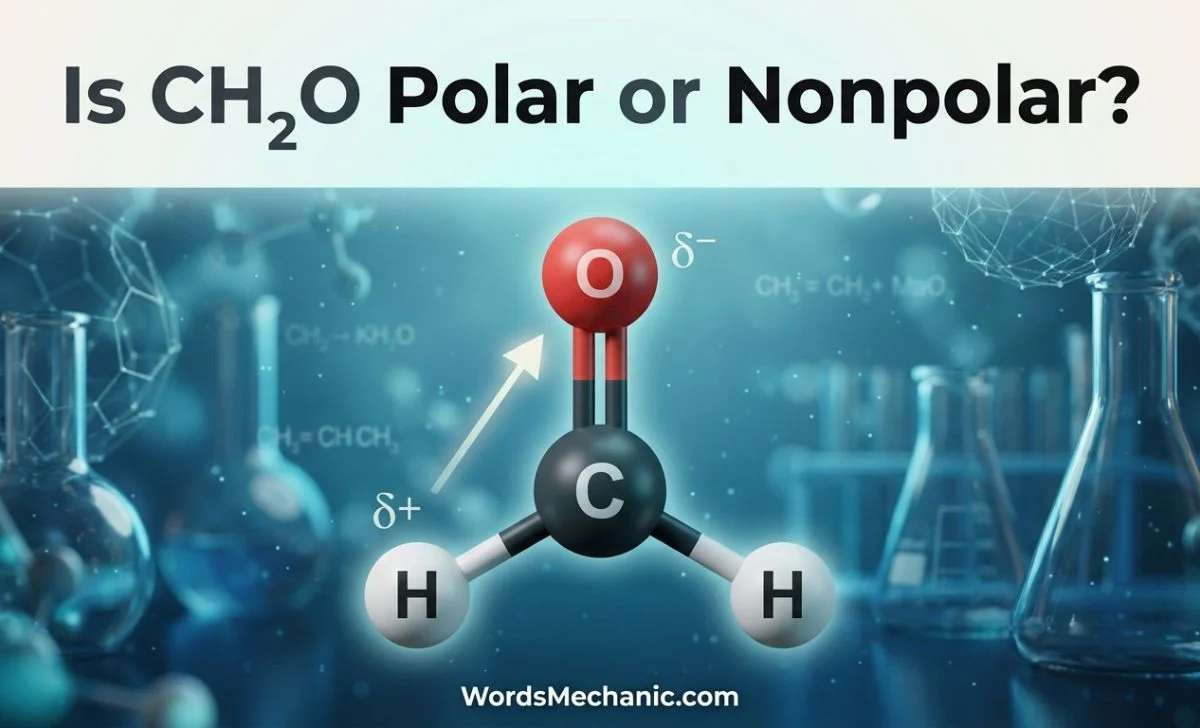
CH₂O is polar. Also known as formaldehyde or methanal, this molecule has an uneven distribution of electrical charge.
Oxygen attracts shared electrons more strongly than carbon and hydrogen, creating a negative end near the oxygen atom.
But electronegativity alone does not explain the whole picture. The Lewis structure, molecular geometry, and dipole moment also help explain why CH₂O is polar.
In this guide, you will learn how to draw its Lewis structure, identify its negative end, understand its molecular shape, and compare its polarity with other common molecules.
Quick Answer:
CH₂O is a polar covalent molecule because its bond dipoles do not cancel. Its oxygen atom attracts electron density toward itself, and the molecule has a net dipole moment of approximately 2.33 debye (D).
Here are the key facts:
- Chemical formula: CH₂O
- Common name: Formaldehyde
- Other name: Methanal
- Molecular geometry: Trigonal planar
- Most electronegative atom: Oxygen
- Negative end: Near oxygen
- Dipole moment: About 2.33 D
- Polarity: Polar
What Is CH₂O?
CH₂O is the chemical formula for formaldehyde, the simplest aldehyde. Its molecule contains one carbon atom, two hydrogen atoms, and one oxygen atom.
The structure is commonly written as H₂C=O. Carbon forms single bonds with both hydrogen atoms and a double bond with oxygen.
Formaldehyde is a colorless gas under ordinary room conditions. It is used to make resins and other industrial chemicals. It is also found in some indoor environments and products.
Its molecular structure is important because the oxygen atom attracts electrons more strongly than the other atoms. This unequal attraction helps explain why formaldehyde is polar.
CH₂O Lewis Structure
A Lewis structure shows how atoms connect and how valence electrons are arranged. It helps you identify the bonds and lone pairs in a molecule.
Step 1: Count the valence electrons
First, count the electrons available for bonding.
| Atom | Number of atoms | Valence electrons per atom | Total electrons |
|---|---|---|---|
| Carbon (C) | 1 | 4 | 4 |
| Hydrogen (H) | 2 | 1 | 2 |
| Oxygen (O) | 1 | 6 | 6 |
| Total | 12 |
CH₂O has 12 valence electrons.
Step 2: Arrange the atoms
Place carbon in the center. Connect each hydrogen atom to carbon with a single bond, then connect oxygen to carbon.
Step 3: Complete the bonds
The correct Lewis structure is:
H₂C=O
Carbon forms two C–H single bonds and one C=O double bond. Oxygen has two lone pairs of electrons.
The C=O double bond consists of one sigma bond and one pi bond. This arrangement gives carbon an octet, while each hydrogen has two electrons in its outer shell.
Why does this structure matter?
The Lewis structure reveals the polar C=O bond. Oxygen pulls the shared electrons toward itself, creating a bond dipole.
However, a polar bond does not automatically make every molecule polar. You must also consider the molecule’s shape and whether its bond dipoles cancel.
Why Is CH₂O a Polar Molecule?
Three factors explain why CH₂O is polar: electronegativity, uneven electron distribution, and molecular geometry.
1. Oxygen has a higher electronegativity
Electronegativity measures how strongly an atom attracts shared electrons in a chemical bond.
The approximate Pauling electronegativity values for the atoms in CH₂O are:
| Atom | Electronegativity |
|---|---|
| Hydrogen (H) | 2.20 |
| Carbon (C) | 2.55 |
| Oxygen (O) | 3.44 |
Oxygen has the highest electronegativity of these three elements. It attracts the shared electrons in the C=O bond more strongly than carbon does.
The difference between carbon and oxygen is about 0.89 on the Pauling scale. This makes the C=O bond strongly polar.
The C–H bonds have a smaller electronegativity difference. They contribute less to the overall polarity than the C=O bond.
2. The electrons are distributed unevenly
Because oxygen attracts more electron density, it develops a partial negative charge, written as δ−. The carbon atom bonded to oxygen develops a partial positive charge, written as δ+.
These symbols represent partial charges, not full electrical charges. The entire CH₂O molecule remains electrically neutral.
The oxygen side has greater electron density, while the carbon side is relatively electron-poor. This creates a separation of charge across the molecule.
3. The bond dipoles do not cancel
A bond dipole describes the separation of positive and negative charge across a chemical bond. A molecule’s net dipole moment depends on the direction and strength of all its bond dipoles combined.
In CH₂O, the strong C=O bond dipole is not canceled by the two C–H bond dipoles. The molecule therefore has a nonzero net dipole moment.
Formaldehyde has a dipole moment of approximately 2.33 D, which confirms that its charge distribution is uneven.
This is the main reason CH₂O is polar.
What Is the Molecular Geometry of CH₂O?
CH₂O has a trigonal planar geometry around its central carbon atom.
According to valence shell electron pair repulsion (VSEPR) theory, regions of electron density around carbon arrange themselves to reduce repulsion.
Carbon has three regions of electron density:
- One C=O double bond
- One C–H single bond
- One C–H single bond
For VSEPR purposes, the double bond counts as one region. These three regions form a roughly flat, triangular arrangement, with bond angles close to 120 degrees.
The shape matters because it determines how the bond dipoles combine. In CH₂O, the dipoles do not cancel, so the molecule remains polar.
Remember: Molecular shape and bond polarity work together. You cannot always determine a molecule’s polarity by looking at its bonds alone.
Which Atom Is Closest to the Negative Side of CH₂O?
Oxygen is closest to the negative end of CH₂O. It attracts shared electrons more strongly than carbon and hydrogen, so electron density shifts toward the oxygen atom.
The carbon atom bonded to oxygen is partially positive. The oxygen atom is partially negative.
This does not mean that oxygen carries a full negative charge. Instead, it has a partial negative charge because the electrons are shared unequally.
If a chemistry question asks you to identify the negative end of CH₂O, choose the oxygen side.
How to Tell If a Molecule Is Polar or Nonpolar
You can use three steps to determine the polarity of most simple molecules.
Step 1: Draw the Lewis structure
Identify the atoms, bonds, and lone pairs. This helps you understand how the atoms are connected.
Step 2: Determine the molecular geometry
Use VSEPR theory to identify the molecule’s shape. Common shapes include linear, trigonal planar, trigonal pyramidal, and tetrahedral.
Step 3: Check the net dipole moment
Determine whether the bond dipoles cancel.
- Polar molecule: The bond dipoles do not cancel, leaving a nonzero net dipole moment.
- Nonpolar molecule: The bond dipoles cancel, or the molecule has no net bond dipole.
CH₂O is polar because its C=O bond dipole is not canceled by the other bond dipoles. CO₂, in contrast, is nonpolar because its two identical C=O bond dipoles point in opposite directions and cancel.
CH₂O Compared With Other Molecules
These common examples show how molecular shape affects polarity.
| Molecule | Name | Molecular geometry | Polarity |
|---|---|---|---|
| CH₂O | Formaldehyde | Trigonal planar | Polar |
| NH₃ | Ammonia | Trigonal pyramidal | Polar |
| CO₂ | Carbon dioxide | Linear | Nonpolar |
| CCl₄ | Carbon tetrachloride | Tetrahedral | Nonpolar |
| CH₂F₂ | Difluoromethane | Tetrahedral | Polar |
| HCN | Hydrogen cyanide | Linear | Polar |
Is NH₃ polar or nonpolar?
NH₃ is polar. Its trigonal pyramidal shape produces an uneven charge distribution, so its bond dipoles do not cancel.
Is CO₂ polar or nonpolar?
CO₂ is nonpolar. Its linear shape places the two identical C=O bond dipoles in opposite directions, allowing them to cancel.
Is CCl₄ polar or nonpolar?
CCl₄ is nonpolar. Its symmetrical tetrahedral geometry allows the four C–Cl bond dipoles to cancel.
Is CH₂F₂ polar or nonpolar?
CH₂F₂ is polar. Its tetrahedral shape contains two C–F bonds and two C–H bonds. The two C–F dipoles and the two C–H dipoles do not cancel because fluorine is much more electronegative than hydrogen.
Is HCN polar or nonpolar?
HCN is polar. It has a linear shape, but its H–C and C≡N bond dipoles do not cancel because the atoms at the two ends are different. It has a net dipole moment.
These examples show why a molecule’s geometry is just as important as the electronegativity of its atoms.
Does CH₂O Form Hydrogen Bonds?
Pure formaldehyde does not typically form hydrogen bonds between its own molecules. Its hydrogen atoms are bonded to carbon, not directly to oxygen, nitrogen, or fluorine.
A common requirement for hydrogen bonding is a hydrogen atom bonded to a highly electronegative atom such as O, N, or F, together with a suitable hydrogen-bond acceptor.
However, formaldehyde’s oxygen has lone pairs and can accept hydrogen bonds from water molecules. Water can donate hydrogen bonds because it contains O–H bonds.
There is another important distinction: when formaldehyde dissolves in water, it reacts with water to form methanediol, also called methylene glycol.
Methanediol has two O–H groups and can participate in hydrogen bonding. In aqueous formaldehyde solutions, methanediol is the predominant form under ordinary conditions.
FAQs
1. Is CH₂O polar or nonpolar?
CH₂O is polar. Oxygen attracts shared electrons more strongly than carbon, and the bond dipoles do not cancel. Its net dipole moment is about 2.33 D.
2. What type of molecule is CH₂O?
CH₂O is a polar covalent molecule and an organic compound known as formaldehyde or methanal. It belongs to the aldehyde family.
3. What is the Lewis structure of CH₂O?
The Lewis structure is H₂C=O. Carbon forms single bonds with two hydrogen atoms and a double bond with oxygen. Oxygen has two lone pairs.
4. Which atom is closest to the negative side of CH₂O?
Oxygen is closest to the negative end because it attracts shared electrons more strongly than carbon and hydrogen.
5. Is CH₂O an acid or a base?
CH₂O is generally treated as a neutral molecular compound rather than a typical acid or base. Its oxygen atom can act as a Lewis base by donating an electron pair in a suitable reaction.
6. What does CH₂O do?
Formaldehyde is used to manufacture resins and other industrial chemicals. In water, it forms methanediol, which is the main form present in many aqueous formaldehyde solutions. Formaldehyde is also a health hazard: the International Agency for Research on Cancer classifies it as carcinogenic to humans (Group 1).
7. Is the C–H bond nonpolar?
The C–H bond is often treated as nonpolar or weakly polar in introductory chemistry because carbon and hydrogen have similar electronegativities. It is much less polar than the C=O bond.
8. Is CH₂Cl₂ nonpolar?
No. CH₂Cl₂, also called dichloromethane, is polar because its bond dipoles do not cancel.
9. Is CH₂NH polar?
Yes. CH₂NH, commonly called methanimine, is polar because its bond dipoles do not cancel, leaving a net dipole moment.
10. What are nonpolar molecules?
Nonpolar molecules have no net dipole moment. Their bond dipoles either do not exist or cancel because of the molecule’s geometry. CO₂ and CCl₄ are common examples.
11. Is CCl₂ polar or nonpolar?
If CCl₂ refers to dichlorocarbene, it is a reactive, bent species and is polar. It should not be confused with CCl₄, which has a symmetrical tetrahedral shape and is nonpolar.
Conclusion
CH₂O is polar because oxygen attracts shared electrons more strongly than carbon and hydrogen.
Its C=O bond creates a strong dipole, and the molecule’s trigonal planar geometry does not allow all its bond dipoles to cancel.
Formaldehyde has a net dipole moment of about 2.33 D, and its negative end lies near oxygen.
The key rule to remember is simple: molecular polarity depends on both bond polarity and molecular shape.