The confusion between “exception or acception” is one of the most common spelling and grammar mistakes in English learning.
Thousands of students search this keyword every month because both words look similar, sound almost the same, and appear to come from related grammar patterns.
Many users write queries like “acception meaning,” “can you make an acception,” or “acception in English sentence,” but in reality, they are trying to understand the correct word exception.
This confusion is not just a spelling issue, it affects academic writing, exams, emails, and professional communication. Incorrect usage can reduce clarity and create grammatical errors.
In this detailed guide, you will learn the exact meaning, pronunciation, origin, differences, usage rules, examples, and mistakes related to exception or acception, so you never confuse them again.
Exception or Acception – Quick Answer
✔️ Correct word: Exception
❌ “Acception” is NOT a valid modern English word
In English Language, exception is defined as:
Something that is not included in a rule, group, or general statement.
Examples:
- Everyone passed the exam, with one exception.
- This rule has no exceptions.
👉 “Acception” is a mistaken word formed due to confusion with “accept.”
Detailed Meaning of Exception
The word exception is used when something does NOT follow a rule or pattern.
Simple explanation:
- Rule applies to everyone
- One case does NOT follow it
→ That case is an exception
Real-life examples:
- All students must attend class, but illness is an exception.
- The offer applies everywhere, with some exceptions.
- He is talented, but there are a few exceptions in his performance.
Acception Meaning – Why It Does NOT Exist
❌ Important fact:
“Acception” is NOT recognized in modern English dictionaries.
It appears only as:
- A mistaken formation
- Rare historical confusion
- Non-standard usage
There is no valid definition in modern grammar.
Instead, learners usually confuse it with:
✔️ Acceptance = approval or agreement
✔️ Exception = rule break or exclusion
So when someone searches “acception meaning,” they actually want:
- exception meaning OR
- acceptance meaning
Pronunciation of Exception or Acception
✔️ Exception pronunciation
/ɪkˈsɛpʃən/ → ik-SEP-shun
Breakdown:
- ex → ik
- cep → sep (stress here)
- tion → shun
❌ Acception pronunciation
No standard pronunciation exists because the word is invalid.
Common mistake:
People often say:
- “ak-sep-shun” ❌
But correct is:
- “ik-SEP-shun” ✔️
Dictionaries like Cambridge Dictionary and Oxford Learner’s Dictionaries only list exception.
Why People Confuse Exception or Acception
In Linguistics, this confusion happens due to several linguistic reasons:
1. Sound similarity
- accept → exception (confusing sound pattern)
2. Word formation assumption
Learners assume:
- verb + tion = noun
So they wrongly create: - accept → acception ❌
3. Mix of two different words
- exception (rule break)
- acceptance (approval)
4. Lack of reading exposure
Many learners hear words but don’t see spelling.
5. Phonetic guessing
People write what they hear, not what is correct.
Easy Trick to Remember Exception or Acception

Memory Rule 1:
- EXception = EXcluded from rule
Memory Rule 2:
- accept → acceptance ✔️
- NOT acception ❌
Final Rule:
- Rule break → exception
- Approval → acceptance
- Acception → ignore forever
Origin of Exception
The word exception comes from Latin:
- Latin: excipere
- Meaning: “to take out” or “to leave out”
It entered English through French and Middle English and became a standard grammatical term.
Important:
- Exception evolved into modern English usage
- Acception did NOT survive language evolution
That’s why it disappeared from modern dictionaries.
British English vs American English Usage
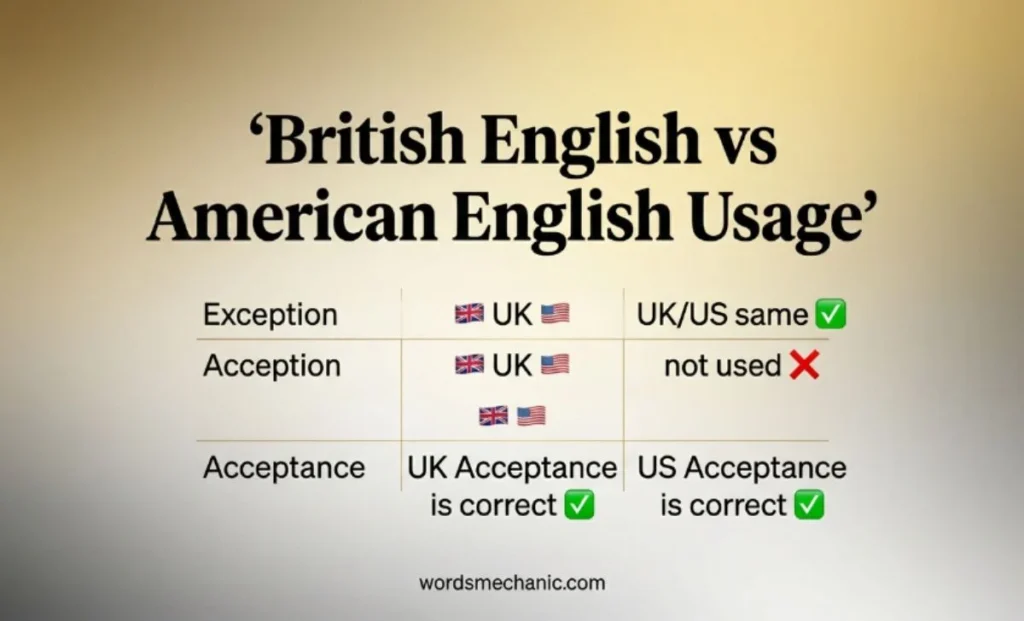
There is NO difference between UK and US English.
| Word | UK English | US English | Status |
|---|---|---|---|
| Exception | exception | exception | ✔️ Correct |
| Acception | not used | not used | ❌ Incorrect |
| Acceptance | acceptance | acceptance | ✔️ Correct |
Which Word Should You Use?
✔️ Use exception when:
- Something breaks a rule
- Something is excluded
✔️ Use acceptance when:
- Something is approved or agreed
❌ Never use “acception” in any situation.
Common Mistakes with Exception or Acception
usage:
- make an acception
✔️ Correct: make an exception
Wrong:
- acception meaning
✔️ Correct: exception meaning
confusion:
- acceptance = exception
✔️ They are different words
Writing mistake in exams:
- spelling acception
✔️ Always write exception
Exception or Acception in Real-Life Usage
📧 Emails:
- “We cannot make an exception to this policy.”
🏫 Academic writing:
- “This case is an exception to the rule.”
💼 Office communication:
- “No exceptions are allowed.”
💬 Social media:
- “Sunday cheat day is my exception 😄”
📰 News writing:
- “The rule applies without exceptions.”
Exception or Acception – Usage Trends

Search behavior shows:
- “exception” → extremely high global usage
- “acception” → incorrect search intent
Most confusion comes from:
- ESL learners
- South Asia
- Middle East regions
- Early English learners
👉 Conclusion: “exception” is globally dominant.
Comparison Table: Exception vs Acceptance vs Acception
| Word | Meaning | Usage | Status |
|---|---|---|---|
| Exception | rule break | very common | ✔️ Correct |
| Acceptance | approval | common | ✔️ Correct |
| Acception | no meaning | never used | ❌ Incorrect |
FAQs
1. Is it “no acception” or “no exception”?
→ Correct phrase is “no exception” because “acception” is not a valid English word.
2. What is the difference between excepted and accepted?
→ Excepted means excluded from a group or rule, while accepted means approved or agreed.
3. What does making an acception mean?
→ It is incorrect. The correct phrase is “making an exception”, meaning allowing a special case.
4. What does exception mean?
→ It means something that does not follow the normal rule or pattern.
5. What are two types of exceptions?
→ In programming, there are checked exceptions and unchecked exceptions.
6. What is the definition of acception?
→ “Acception” is not a valid English word in modern usage.
7. Is exceptional a good compliment?
→ Yes, it means someone or something is very outstanding or impressive.
8. What is a better word than exceptional?
→ Better words include outstanding, remarkable, extraordinary.
9. What word is higher than exceptional?
→ Words like phenomenal, unparalleled are stronger than exceptional.
10. What is a fancy word for an awesome person?
→ You can say remarkable individual or extraordinary personality.
11. How do you compliment a beautiful girl?
→ You can say: You look elegant, stunning, or beautiful.
12. How do you say “very good” professionally?
→ Use words like excellent, outstanding, highly effective.
13. What is the opposite of exceptional?
→ The opposite words are ordinary, average.
14. What is a positive word for exceptional?
→ Positive synonyms include remarkable, superb.
15. What can I use instead of exception?
→ You can use special case or exclusion, depending on context.
16. How do you say excellent professionally?
→ Use exemplary or superior.
17. How does Gen Z say good?
→ Gen Z slang includes fire, lit, solid.
18. How do I say I love my job professionally?
→ Say: I am passionate about my work.
19. How do you professionally say “stay in your lane”?
→ Say: Please focus on your assigned responsibilities.
20. How do you say “let’s keep in touch” professionally?
→ Say: Let’s stay connected for future collaboration.
21. How to say goodbye professionally?
→ Say: Looking forward to staying in touch.
22. What are the 3 C’s of professionalism?
→ Competence, Communication, Courtesy
23. What is the 3 email rule?
→ Keep email exchange within 3 replies for efficiency.
24. How to professionally say “keep this between us”?
→ Say: Please treat this as confidential.
25. What is looping ++ in email?
→ It means repeatedly adding more people to an email thread for visibility.
Conclusion
The confusion between exception or acception is common but easy to fix once you understand the logic.
The correct word is always exception, while “acception” is not part of modern English vocabulary.
If you mean approval, use acceptance, and if you mean something outside a rule, use exception.
Mastering this difference improves your grammar accuracy, writing quality, and communication skills.
Always remember: exception is correct, acceptance is approval, and acception should never be used in English writing.
Discover More Blog :
- Momment or Moment – Correct Spelling Explained
- Descendent or Descendant: Correct Spelling Explained Simply
- Got or Gotten: Which One Is Correct in English Grammar?