When you move a shopping cart, open a drawer, or kick a ball, you use force. Some actions push an object away, while others pull it closer.
These simple movements help explain one of the basic ideas in physics.
A push or a pull is a way of applying a force. Forces can change an object’s speed, direction, or shape.
They can also start or stop movement. Learning to recognize pushes and pulls makes it easier to understand how objects move in everyday life.
What Is a Push in Physics?
A push is a force that tends to move an object away from the source of the force. You can push an object with your hand, foot, or another object.
For example, when you push a shopping cart forward, your hands apply force to the handle. The cart may begin moving or speed up, depending on the other forces acting on it.
Common examples of a push include:
- Pushing a shopping cart.
- Kicking a football.
- Pressing a button.
- Pushing a door closed.
- Shoving a box across the floor.
A push does not always make an object move. If you push a heavy wall, you still apply force even though the wall stays in place.
The wall pushes back on you with an equal force in the opposite direction. Because the wall is supported by the building and the ground, it does not move noticeably.
What Is a Pull in Physics?
A pull is a force that tends to draw an object toward the source of the force. You can pull an object directly or use something such as a rope or handle.
For example, when you pull a drawer open, your hand applies force to the handle and draws the drawer toward you.
Common examples of a pull include:
- Pulling a drawer open.
- Tugging a rope.
- Pulling a suitcase by its handle.
- Drawing a chair toward yourself.
- Pulling a bucket up from a well.
Like a push, a pull may change an object’s motion, speed, or direction. However, pulling does not guarantee that an object will move.
A heavy box may stay in place if the force is not enough to overcome friction and other opposing forces.
What Is the Difference Between a Push and a Pull?
The main difference is the direction in which the force tends to act relative to its source.
| Push | Pull |
|---|---|
| Tends to move an object away from the source of force. | Tends to draw an object toward the source of force. |
| Often involves pressing, shoving, or kicking. | Often involves tugging, drawing, or dragging. |
| Example: Pushing a shopping cart forward. | Example: Pulling a suitcase behind you. |
| Example: Pressing a button. | Example: Pulling a rope toward yourself. |
Both actions apply force, and both can affect an object’s motion or shape. Neither action always causes movement because other forces may oppose it.
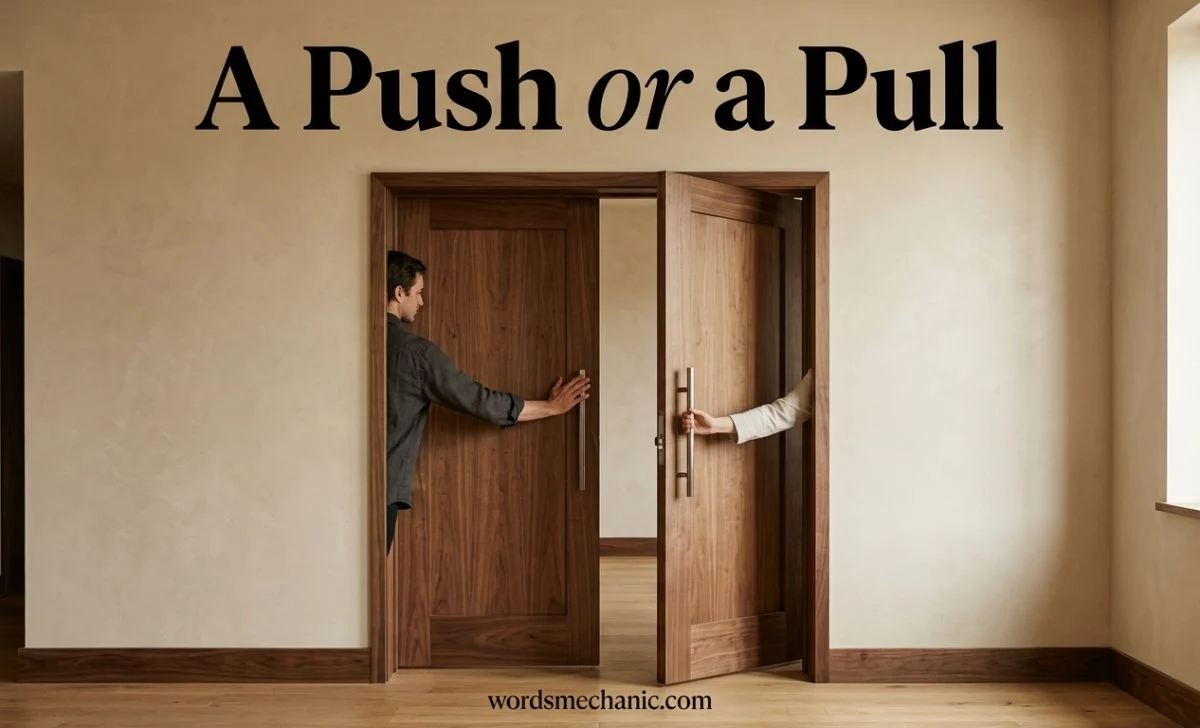
Remember: Whether a door requires a push or a pull depends on its design and which side you are standing on.
You might push one door closed but pull another door closed. The action depends on how you apply the force, not simply on whether the door is opening or closing.
10 Examples of Push and Pull in Everyday Life
The following examples show how pushing and pulling work in familiar situations.
| Everyday action | Type of force | Explanation |
|---|---|---|
| 1. Pushing a shopping cart | Push | Your hands apply force to move the cart forward. |
| 2. Pulling a drawer open | Pull | You draw the drawer toward yourself. |
| 3. Kicking a football | Push | Your foot applies force to the ball. |
| 4. Pulling a suitcase | Pull | You draw the suitcase using its handle. |
| 5. Pressing a keyboard key | Push | Your finger applies force to the key. |
| 6. Tugging a rope | Pull | You draw the rope toward yourself. |
| 7. Pushing a toy car | Push | Your hand applies force to move the car. |
| 8. Pulling a wagon | Pull | You draw the wagon using its handle. |
| 9. Pushing a swing | Push | You apply force to move the swing. |
| 10. Pulling a chair closer | Pull | You draw the chair toward your body. |
These examples show that the same object can experience a push or a pull. A chair, for instance, can be pushed away from you or pulled closer to you.
How Do Push and Pull Forces Affect Objects?
Forces can affect objects in several ways. The result depends on the strength and direction of the force and on the other forces acting on the object.
A Force Can Start or Stop Movement
Pushing a stationary toy car can make it move. Applying a force against a moving object can slow it down or bring it to a stop.
A Force Can Change Speed
A push can make a moving swing go faster. A force acting against an object’s movement can slow it down.
A Force Can Change Direction
When a moving football is struck by a player’s foot, the force can send it in a different direction. The ball’s direction depends on how the force acts on it.
A Force Can Change Shape
Squeezing a sponge or stretching a rubber band changes its shape. These actions show that a force can deform an object, even when it does not move from one place to another.
An Object Can Stay Still When You Apply Force
Pushing a wall is a useful example. Your hands apply force to the wall, and the wall applies an equal force back on your hands in the opposite direction. This is an example of Newton’s third law of motion.
The wall remains still because it is supported by the building and ground. Those supports provide forces that balance the forces acting on the wall. The lack of visible movement does not mean that no force is being applied.
Are Push and Pull Forces Contact Forces?
Many pushes and pulls are contact forces, meaning the objects interact through physical contact. Pushing a box, pulling a rope, and pressing a button are common examples.
However, not all forces require direct contact.
Gravity pulls objects toward Earth without requiring Earth to touch them. A magnet can also attract certain materials from a distance. These are examples of forces that act without direct physical contact.
This distinction is important in physics. A push or pull describes how a force tends to act, while contact and non-contact describe how the force acts between objects.
A Push or a Pull Quiz
Test your understanding with these five multiple-choice questions.
1. What is a push or a pull called in physics?
A. Energy
B. Force
C. Distance
D. Temperature
2. Which action is an example of a pull?
A. Kicking a ball
B. Pressing a button
C. Pulling a drawer open
D. Pushing a cart
3. What can a force do to an object?
A. Change its motion
B. Change its direction
C. Change its shape
D. All of the above
4. Why can a wall remain still when you push it?
A. No force acts on the wall.
B. The wall has no weight.
C. The forces on the wall are balanced.
D. A push cannot affect solid objects.
5. Which force can act without direct physical contact?
A. Pushing a chair
B. Pulling a rope by hand
C. Pressing a key
D. Gravity
Quiz Answers
- B. Force. A push or a pull is a way of applying force.
- C. Pulling a drawer open. You draw the drawer toward yourself.
- D. All of the above. A force can change motion, direction, or shape.
- C. The forces on the wall are balanced. The wall remains still because the forces acting on it balance.
- D. Gravity. Gravity acts between objects without requiring direct physical contact.
A Push or a Pull Worksheet
Use this worksheet to practise identifying forces in everyday situations.
Activity 1: Identify the Force
Write push or pull for each action.
- Moving a shopping cart forward: ______
- Drawing a suitcase toward yourself: ______
- Pressing a door to close it: ______
- Tugging a rope toward yourself: ______
- Moving a chair closer to your desk: ______
- Kicking a football away: ______
- Pulling a bucket up from a well: ______
- Pressing a button on a remote control: ______
Activity 2: Complete the Sentences
- A push or a pull is a way of applying a ______.
- Kicking a football is an example of a ______.
- Drawing a drawer toward yourself is an example of a ______.
- A force can change an object’s speed, direction, or ______.
- Gravity can act without direct physical ______.
- When the forces acting on a stationary wall are balanced, the wall remains ______.
Worksheet Answer Key
Activity 1
- Push
- Pull
- Push
- Pull
- Pull
- Push
- Pull
- Push
Activity 2
- Force
- Push
- Pull
- Shape
- Contact
- Still
FAQs
What Is a Push or a Pull Called?
A push or a pull is a way of applying a force. A force can change an object’s motion, direction, speed, or shape.
What Is a Word for Push and Pull?
In physics, the word force describes both a push and a pull. The two actions differ in the direction in which the force tends to act.
What Are Five Examples of Push or Pull?
Five examples are pushing a shopping cart, pulling a drawer, kicking a football, tugging a rope, and pulling a suitcase.
What Is the One-Word Answer for Push or Pull?
The one-word answer is force.
What Is Another Word for Push?
Depending on the context, another word for push is shove, press, or thrust. These words have slightly different meanings, so they are not interchangeable in every sentence.
What Is Another Word for Pull?
Depending on the context, another word for pull is tug, draw, or drag. For example, tug often suggests a short, strong pull, while drag often means moving something along a surface.
What Does Push and Pull Mean?
Push and pull describe two ways of applying force. A push tends to move an object away from the source of force, while a pull tends to draw it toward the source.
Can an Object Experience Both Push and Pull Forces?
Yes. An object can experience several forces at once. For example, one person can push a box while another person pulls it in the opposite direction. The box’s motion depends on the combined effect of the forces.
Is Opening a Door a Push or a Pull?
It can be either. The action depends on the door’s design, the side you stand on, and the direction in which you apply force. You may push a door open from one side and pull it open from the other.
Conclusion
Pushes and pulls are common ways of applying force. A push tends to move an object away from the source of force, while a pull tends to draw it toward the source.
Both can change an object’s motion, speed, direction, or shape. Everyday actions such as moving a cart, kicking a ball, opening a drawer, and pulling a rope make these ideas easy to understand.
Once you can recognize these actions, you can better explain how forces affect objects around you.
Discover More Blogs :
- Dived or Dove: Exploring the Forms and Sounds of Dive
- Fiending or Feening: The Real Meaning Behind the Word
- Skiis or Skis: The Correct Word for More Than One Ski
- Treck or Trek: The Correct Word for Every Adventure
- Journies or Journeys: A Closer Look at the Plural Form of Journey
- Seel or Seal: The Spelling Difference That Matters